Two bells, two kinds of presence
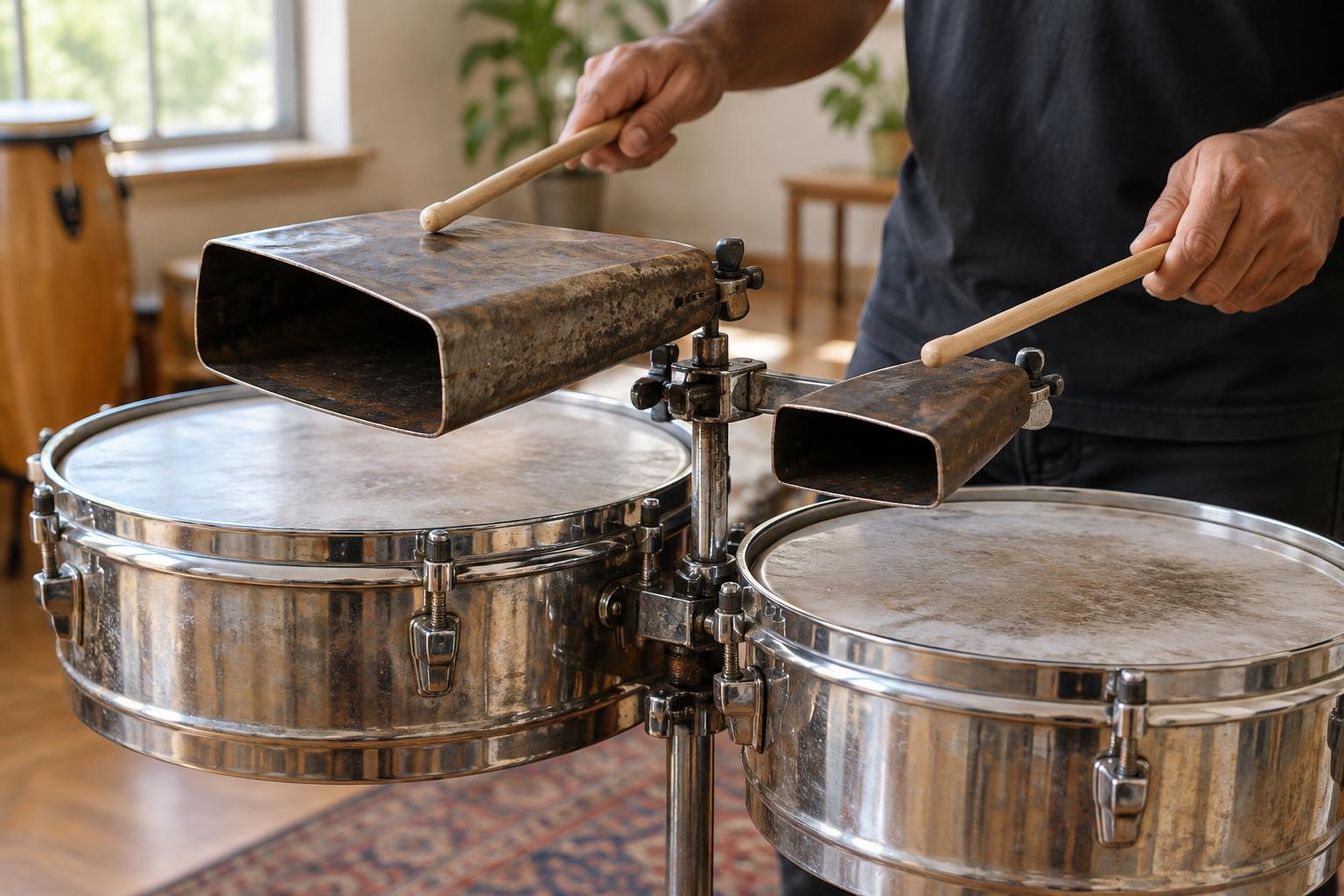
A timbalero may have more than one metal bell mounted near the drums. The larger bell generally has a lower pitch and a fuller, more open sound; a smaller bell generally sounds higher and sharper. Players and bandleaders use different names for their bells, so “low” and “high” are useful descriptions rather than guarantees about a particular setup.
Pitch is only part of what you hear. The low bell can feel broad and anchoring, especially when it states a repeated pulse. The high bell can cut through a busy ensemble with a shorter, brighter attack. Neither bell is limited to one job: how hard it is struck, where it is struck and whether its sound is damped can change its character. When listening, attend to the space after each hit as well as the initial clang.
Listen for roles, not a universal pattern
In many Afro-Cuban dance-music arrangements, the timbales part changes as the ensemble moves between sections. A player might use the shell of a drum for a lighter texture, then bring in a bell when the music opens into a more active passage. A lower bell may make the beat easier to follow, while a higher bell may add a lively answering rhythm or brighter accents. These are listening possibilities, not rules for every style or recording.
Bell parts belong to an interlocking texture. Congas, bongó, bass, piano, voices and other instruments may each supply a different piece of the rhythmic picture. Clave helps organize that picture, but a bell pattern is not necessarily a direct copy of the clave rhythm. Rather than deciding which bell is “playing the clave,” notice where its accents land in relation to the beat, the phrase and the other parts.
You may hear the larger bell called a mambo bell and a smaller one called a cha-cha bell. Those names can be helpful in a rehearsal, but they do not mean that every mambo or cha-cha-chá uses one fixed bell pattern. The arrangement and the player’s choices matter.
A listening method for telling them apart
Start with a passage where the percussion is easy to hear. Tap a steady four-count without trying to transcribe anything. Then focus on the metal sounds alone. Is one bell deeper and more resonant? Does another have a higher, more piercing note? If both are present, follow one for several measures before switching your attention to the other. This is often easier than trying to separate them simultaneously.
Next, listen for repetition. Mark the beats on which the lower sound returns, then listen again for higher sounds that fill gaps or emphasize different moments. Finally, pay attention to changes: does a bell enter when singers begin a repeated response, or disappear when the texture becomes quieter? Such entrances can tell you more about a bell’s role than a single isolated measure.
Recordings can blur the distinction. Microphone placement, equalization and other instruments may mask a bell’s pitch. If you cannot confidently identify two separate bells, describe what you can hear—such as “a bright offbeat accent”—rather than forcing a low-or-high label.
Practice the contrast before learning a full part
You can explore the distinction with two bells, two safely placed metal sounds or even two contrasting tabletop taps. Set a comfortable pulse and count “1 and 2 and 3 and 4 and.” Play the lower sound on each numbered beat for several cycles. Keep the spacing even and let the notes ring naturally. Then play the higher sound on each “and” while continuing to count. This is a coordination exercise, not a prescribed Afro-Cuban bell pattern.
Once both placements feel steady, alternate them: low on the numbers, high on the “ands.” Record a short attempt and listen back. Can you hear two distinct layers, or are you rushing the higher notes toward the next beat? Try reversing the roles, too. The point is to recognize each sound and its location in time, not to associate one pitch permanently with beats and the other with offbeats.
To connect the exercise to music, return to a recording and listen without playing. Tap the main pulse, identify one bell sound, and notice its accents over a longer phrase. If you later learn a style-specific part, work from a knowledgeable teacher or a clear example in its musical context rather than treating this basic drill as the part itself.
Make the bell serve the ensemble
A useful bell part is not simply loud or intricate. The timbalero balances clarity with space for voices, melody and the rest of the rhythm section. For developing players, that means practicing consistent tone and volume as carefully as the sequence of strokes. For listeners, it means hearing a bell as one participant in a shared groove.
The low-versus-high distinction is a starting point: pitch and timbre help you find each voice, while repetition and changes in the arrangement reveal what it is doing. With attentive listening, two metal sounds become easier to hear as distinct musical choices rather than a single wash of percussion.