A small instrument with an ensemble-sized role
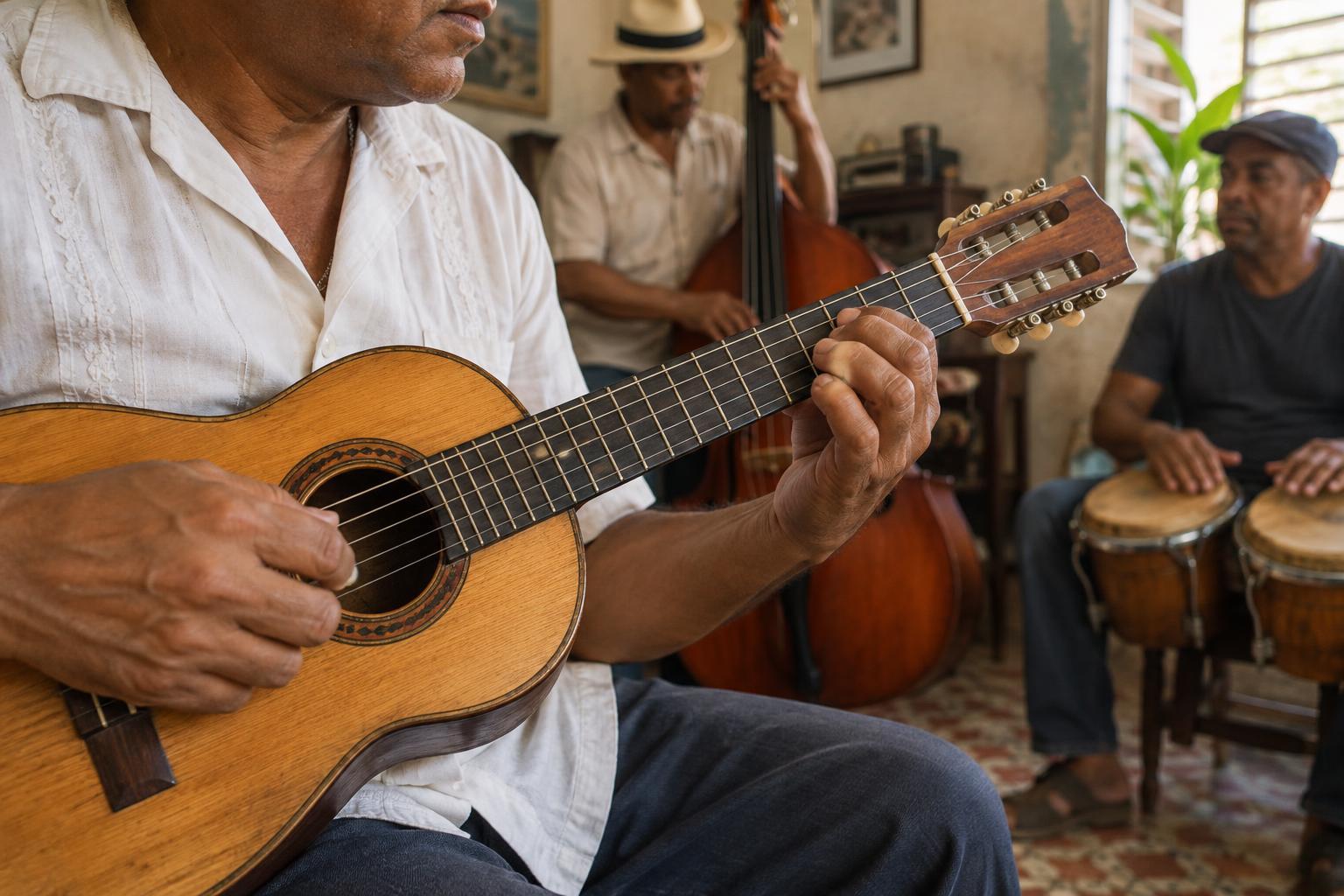
The Cuban tres is a string instrument closely associated with son, a musical tradition that developed in Cuba through the contributions of musicians from different communities, including Black Cuban musicians. A tres commonly has six strings arranged in three pairs, or courses, though instruments and tunings can vary. Players often use a pick to bring out a crisp, ringing attack. That sound can be easy to recognize, but its role in an ensemble is more important than its brightness alone.
Rather than filling every beat with full chords, a tres player often plays a guajeo: a short, repeating figure shaped around the song’s harmony and rhythm. The figure may combine single notes, paired strings and compact chord sounds. Repetition gives the group a dependable point of reference, while small changes keep the part responsive to the singer and other musicians. In son, a useful tres part is not simply a tune repeated on top of an accompaniment. It helps make the accompaniment move.
How a guajeo finds its place in the groove
A guajeo gains much of its energy from where its notes land and where the player leaves silence. Some attacks may fall between the main beats, while others reinforce a beat or lead toward the next measure. A bass line can suggest the arrival of a new chord before that chord feels fully settled; the tres may answer with a note or chord fragment that makes the change clear. These parts work together without needing to play at the same moment.
Clave is another point of orientation. In many son settings, its two-measure pattern helps organize musical phrases, even when no one is striking the pattern aloud. A tres figure can be shaped to sit comfortably within that cycle, but it need not copy the clave strokes. Nor can every tres phrase be understood by labeling it 3–2 or 2–3 in isolation: the wider arrangement and the start of the musical phrase matter. Listen for a recurring relationship among tres, bass and percussion rather than trying to match every note to a single template.
Harmony without crowding the singer
The tres can outline chord changes with only a few notes. Moving one note of a repeating figure when the harmony changes may be enough to signal a new chord while preserving the figure’s familiar shape. This economy is valuable in an ensemble where voice, bass, percussion and, in some groups, other melodic instruments all need room. The tres can supply harmonic information without sustaining a dense chord through every vocal line.
Its repetition also creates opportunities for response. A player might keep the same basic figure under a verse, then adjust its ending after a sung phrase. In a more open, repeated section, the figure can become a steady foundation for vocal calls and replies. Those variations are not a license to fill every gap. Part of the craft is deciding when a familiar pattern will support the song better than a new flourish.
Listening to the tres in an ensemble
To hear the tres clearly, begin by following its tone rather than trying to identify every note. Notice the short, bright attacks and ask whether they form a phrase that returns. Then listen beneath that phrase for the bass. Does the bass arrive with the tres, or does one part seem to anticipate the other? Shift your attention to the percussion and notice how its continuing pulse gives the string figure something to play around.
On a second listen, follow the singer. Notice when the tres repeats unchanged and when it varies an ending, emphasizes a chord change or becomes less busy. Son ensembles can use different combinations of instruments, so the exact balance will vary from recording to recording. The listening goal is not to find one definitive tres pattern. It is to hear how a repeating part contributes direction while making space for the rest of the group.
Try building a supportive repeating figure
You can explore the idea on a tres, guitar, keyboard or even by singing notes. Set a comfortable, steady pulse and alternate between two simple chords over a two-measure cycle. Choose two or three notes from the first chord and make a short phrase with at least one rest. Repeat it several times. When the chord changes, alter only the notes needed to fit the new harmony. Aim to keep the rhythmic shape recognizable rather than composing a fresh phrase every measure.
Next, have a partner mark the main beats or play a simple bass part. Move one attack slightly earlier in the measure, then try leaving that attack out. Notice which version makes the other part easier to hear and the chord change easier to feel. Finally, sing a short line over the pattern. If the figure competes with the voice, remove a note before adding anything else. This exercise is not a prescribed son guajeo; it is a way to practice the restraint, repetition and attentive interaction that make a tres part useful in an ensemble.