Set up a pulse you can trust
A sixteenth-note grid divides each beat into four equal places. In a measure of four beats, you can speak those places as “one e and a, two e and a, three e and a, four e and a.” The numbers mark the beats; the other syllables mark positions between them. Think of the count as a map, not a demand to play every note on it.
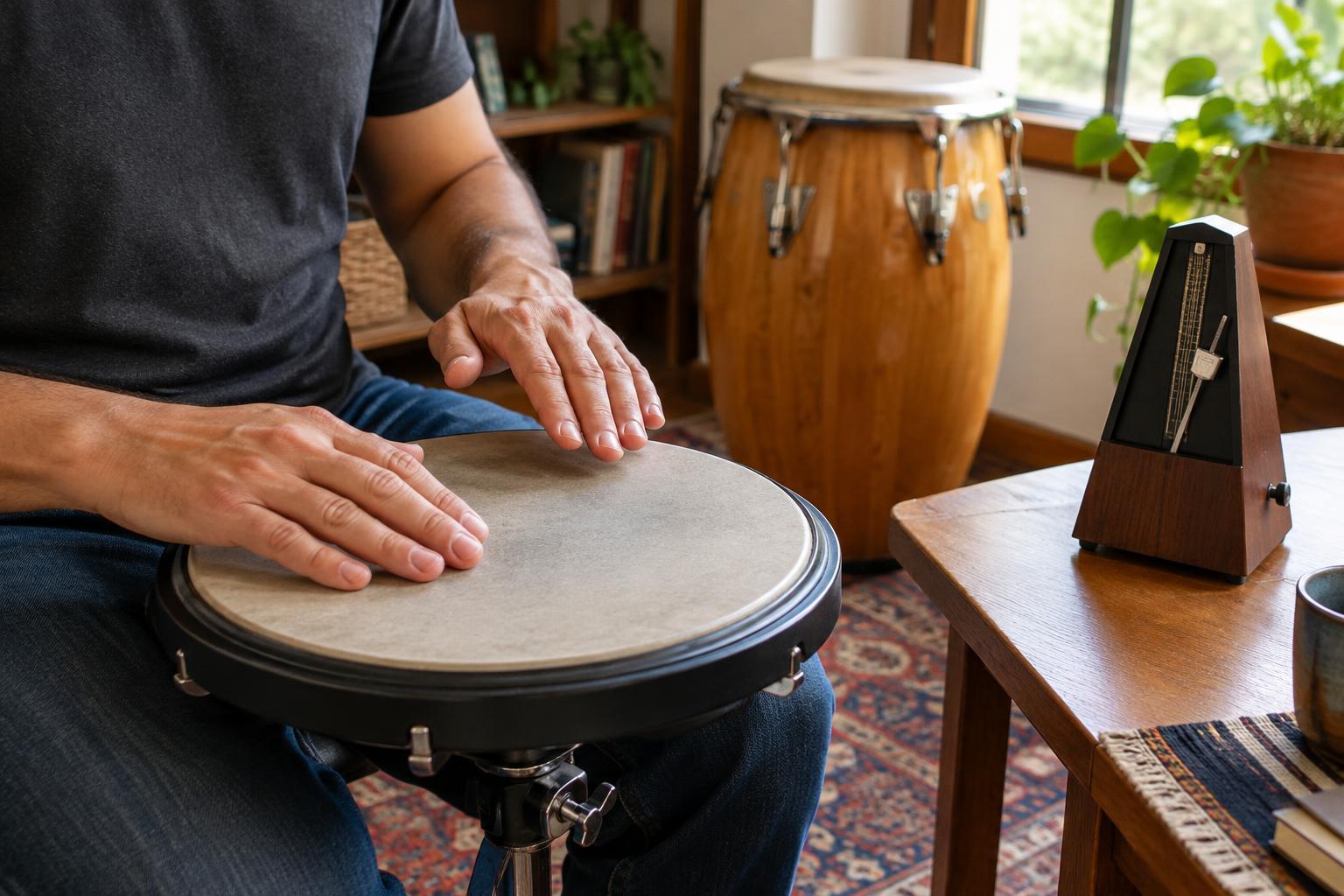
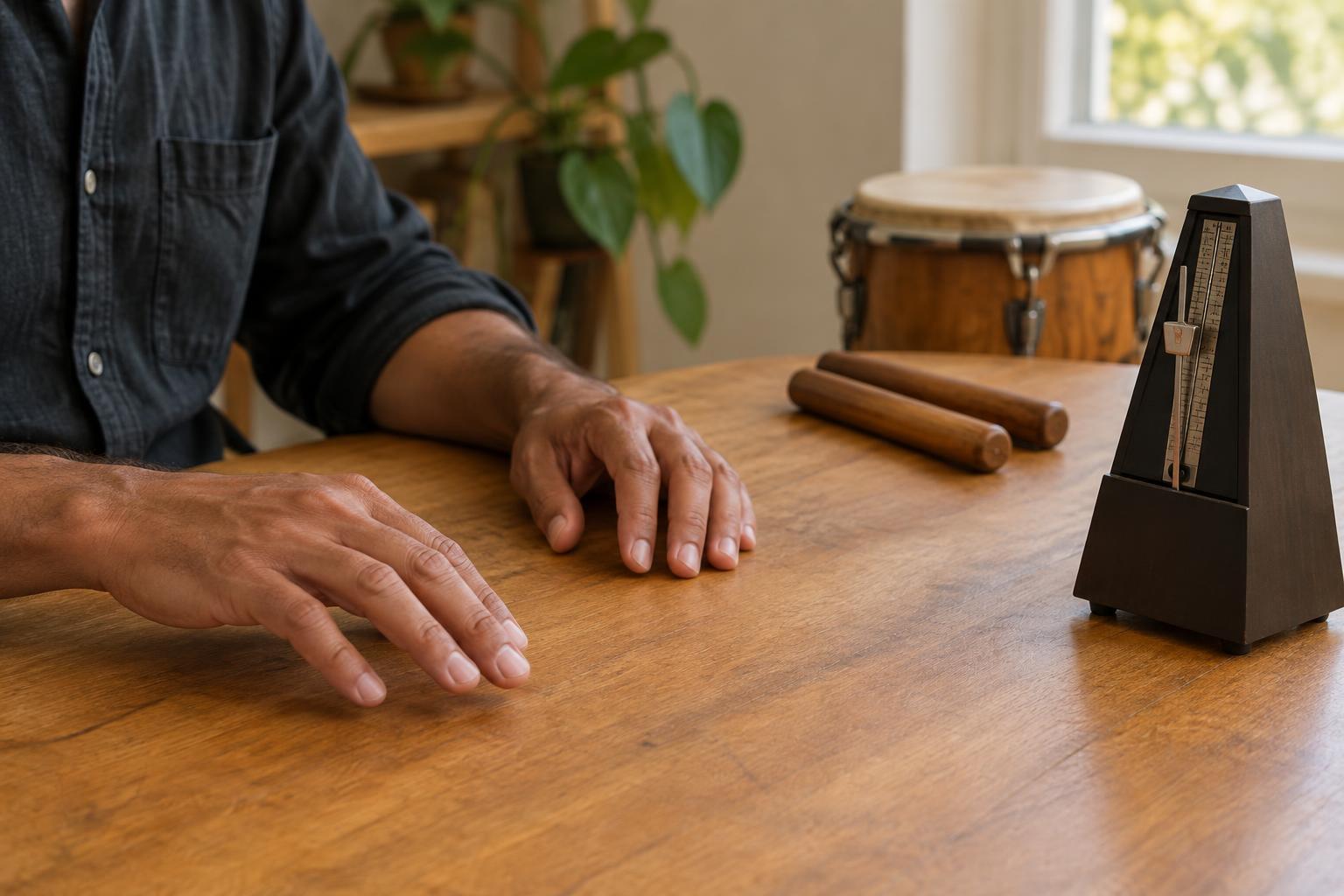
Choose a pace at which you can say the full count without hurrying or clipping syllables. A metronome can mark the beats, but you can also begin by tapping a steady pulse with one hand. Speak the numbers along with the taps, leaving enough space to fit “e and a” evenly between them. If the words feel crowded, slow the pulse. A comfortable tempo is one that lets you notice where each syllable falls.
Keep the pulse tap small and relaxed. Your goal is not to make four identical movements with every part of your body. It is to hear four evenly spaced positions while the beat remains clear. Work for a few measures, pause, and begin again. A clean restart is more useful than pushing through a count that has drifted.
Speak first, then choose where to tap
Once the spoken count feels even, keep saying every syllable and tap only on the numbers: “one,” “two,” “three,” and “four.” Your voice supplies the grid while your hand shows the beat. Then reverse the task: keep speaking the full count, but tap on each “and.” These taps should land halfway between consecutive beat taps, not just somewhere after a number.
Next, try a short pattern within each beat. Speak “one e and a” and tap on “one” and “a.” Repeat the same pair on beats two, three and four. The “a” is close to the next number, which makes it tempting to rush. Listen for an even space from “and” to “a” and from “a” to the next number, even though you are not tapping on “and.”
For a different challenge, tap on “e” and “and” while continuing to say all four syllables. Resist the urge to give the tapped syllables extra length. If coordinating voice and hand becomes difficult, return to tapping only the numbered beats. That is not a step backward; it restores a clear reference point for the next attempt.
Use rests and accents to check your placement
A silent position is still part of the grid. Speak one beat as “one e and a,” tapping on “one,” “e,” and “a” but resting on “and.” Repeat that shape on each beat. Keep the spoken “and” just as even as the other syllables. You can then try tapping only on “a,” letting your voice carry you through the three untapped positions before it.
Accents offer another test. Tap all four positions within each beat, but make only the numbered tap a little stronger. Then shift the accent to “and” while keeping all four taps evenly spaced. An accent changes emphasis, not timing: the stronger tap should not arrive early, and the following tap should not be delayed. Use a light motion so that volume does not become a struggle.
Change just one thing at a time. If you move both the rests and the accents on every pass, it may be hard to tell what caused a stumble. Repeat a pattern until you can enter it on beat one, complete four beats, and stop without adding an extra tap. Then choose a new position to leave silent or emphasize.
Bring the grid into listening and musical practice
Try listening to a recording with a pulse you can follow. First find and tap the beat. Then, without trying to identify every instrument, quietly speak a sixteenth-note count against that pulse for a few beats. Notice whether a sound falls on a number, between numbers, or across several positions. If the count feels forced, set it aside and listen for the pulse again; not every musical phrase is best understood by counting aloud.
This grid is a coordination tool, not an explanation of an entire musical tradition. In Afro-Cuban music, rhythmic parts often relate to recurring patterns and to one another in ways that require attentive listening beyond a single subdivision exercise. When practicing a specific groove or clave-related part, learn its phrasing and relationship to the other parts rather than treating a string of sixteenth-note taps as the music itself.
Finish with a short check: speak one measure of the full grid, tap a chosen pattern for the next measure, and return to tapping only the beat. If the beat feels unchanged when you return, you have kept your bearings. Stay at that comfortable pace while the placement grows reliable; speed can wait.