Start with the beat, not the time signature
When you tap along to music, each steady tap is a beat. Between those taps, you may hear smaller, evenly spaced notes: subdivisions. Meter describes how beats are grouped, while simple and compound describe how each beat is typically subdivided. In simple meter, a beat divides into two equal parts. In compound meter, it divides into three.
Try saying “ONE and TWO and” while tapping on the numbers. Each tap has two syllables: that is a simple subdivision. Now say “ONE and a TWO and a,” still tapping only on the numbers. Each tap has three syllables: that is a compound subdivision. Keep the taps evenly spaced in both versions. The change is in what fits between them, not necessarily in how fast your hand moves.
How time signatures point to the grouping
Common simple meters include 2/4, 3/4 and 4/4. In each, the quarter note commonly serves as the beat, and pairs of eighth notes can divide it evenly. The number of beats per measure differs: two in 2/4, three in 3/4 and four in 4/4. All three can still have the same two-part subdivision of each beat.
Common compound meters include 6/8, 9/8 and 12/8. These are often felt as two, three and four larger beats per measure, respectively. Each larger beat lasts as long as three eighth notes and is written as a dotted quarter note. For example, a typical 6/8 measure groups its six eighth notes as 3 + 3: “ONE and a TWO and a.”
A time signature is a useful clue, but notation alone does not tell you every accent or every way a passage might be felt. Listen for the recurring beat and the grouping around it. Musicians can also play three notes across a beat in simple meter, or two across a beat in compound meter. Those contrasts do not automatically change the underlying meter.
Why 3/4 and 6/8 do not feel the same
Both 3/4 and 6/8 can contain six eighth notes in a measure. The difference is where you place the larger beats. In a straightforward 3/4 passage, you might count “ONE and TWO and THREE and,” tapping three times. In a straightforward 6/8 passage, count “ONE and a TWO and a,” tapping twice. The small notes may pass at the same speed, yet the two patterns invite different movements.
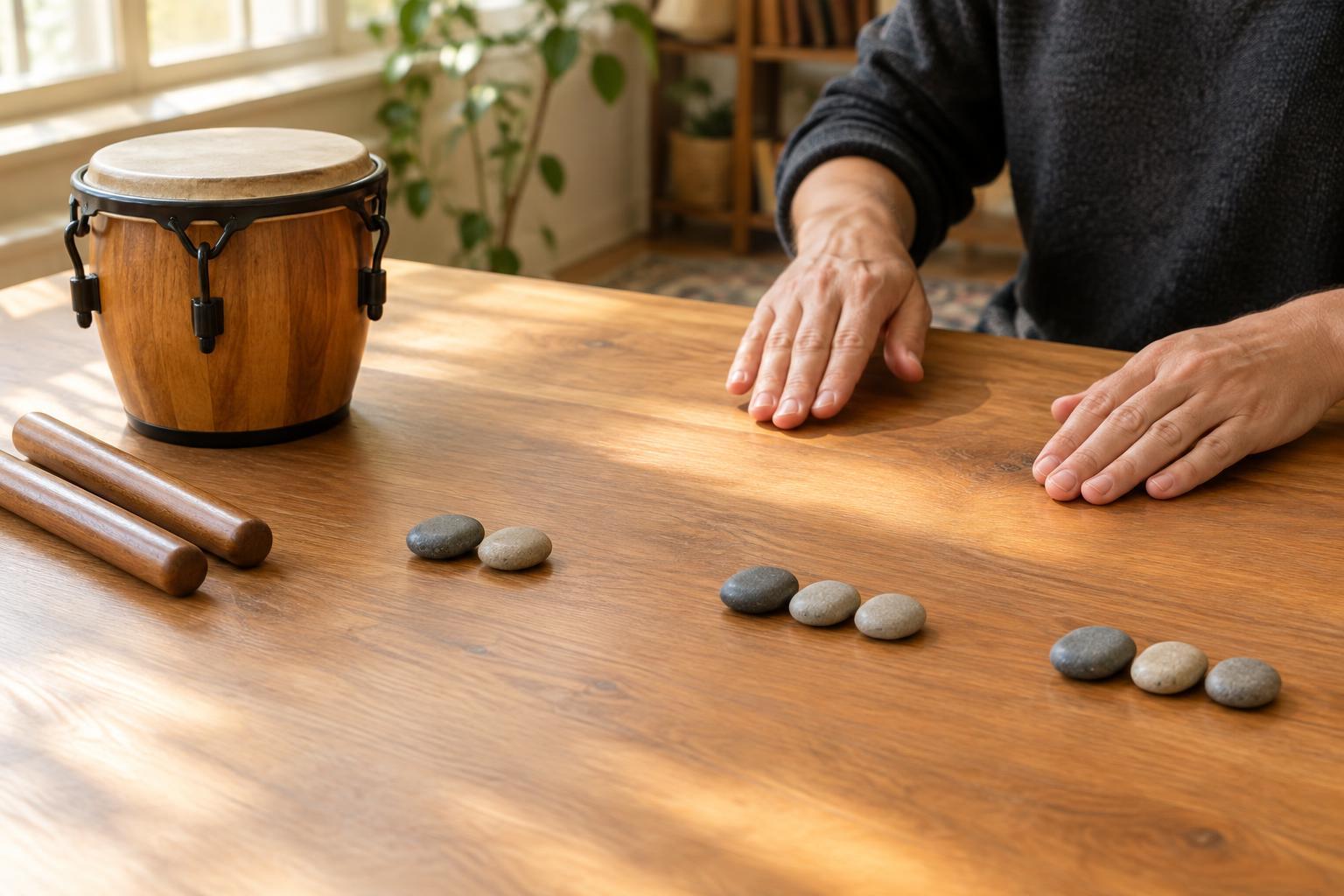
To hear that difference without an instrument, say six evenly spaced syllables: “ta ta ta ta ta ta.” First emphasize syllables one, three and five. Then emphasize one and four. You have not changed the number of syllables; you have changed their grouping. In actual music, melody, bass, percussion and phrasing can reinforce a grouping—or play against it—so an accent in one instrument is not always the whole story.
Listen for layers, not labels alone
Rhythm traditions often make this distinction more interesting than a classroom count suggests. In Afro-Cuban music, interlocking percussion parts may mark different points within a repeating cycle. Some repertories and arrangements use a prominent three-part subdivision, while others invite a two-part feel or create tension between the two. Rather than assign a meter from one isolated instrument, listen for where the ensemble’s larger pulse settles.
Clave is a useful reminder to separate a rhythmic pattern from a time signature. A clave pattern helps organize musical phrases and relationships among parts; the word does not itself mean “simple meter” or “compound meter.” If you are learning a specific Afro-Cuban style, attend to how its musicians place the beat, phrase the pattern and connect the parts, instead of assuming that a written grouping explains the entire groove.
A short practice routine
Set a comfortable, unhurried pulse by tapping your foot or using a metronome. For four taps, speak two even sounds per beat: “ONE and TWO and THREE and FOUR and.” Repeat until the foot remains steady. Then keep the same foot pulse and fit three even sounds into each beat: “ONE and a TWO and a THREE and a FOUR and a.” Do not speed up the foot to make room; give the spoken sounds equal space.
Next, make the 3/4–6/8 comparison. Tap three beats while speaking six even syllables, then tap two beats over six syllables. Alternate several times, noticing which syllables line up with your taps. Finally, try the exercise while listening to music: tap a possible larger beat, quietly fill in its subdivisions, and check whether that pulse continues to make sense through a complete phrase. If it does not, try another grouping. The goal is not to force every rhythm into a label, but to hear how smaller sounds gather around a steady beat.