What three-against-two means
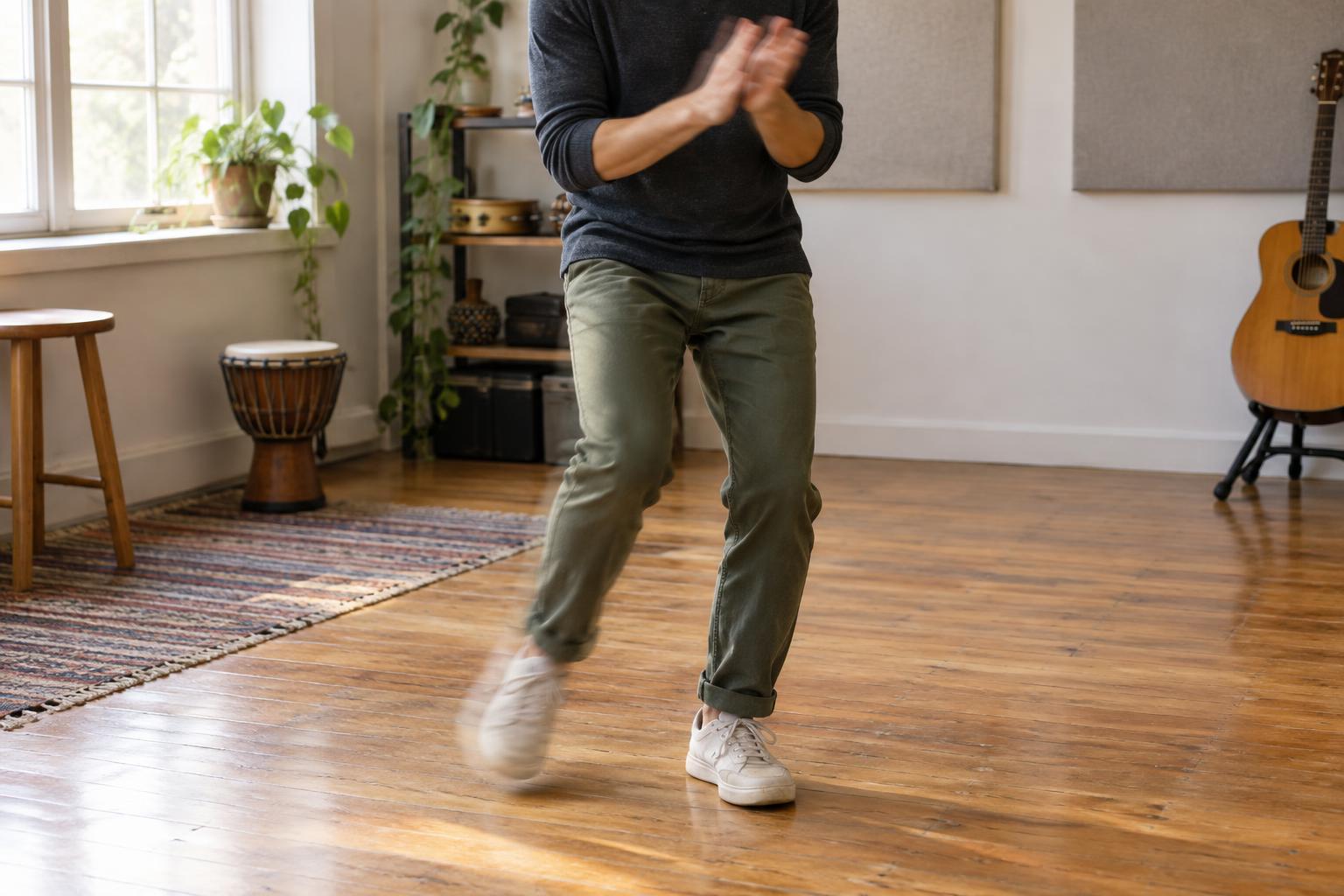
Three-against-two is a way of fitting three evenly spaced actions into the same length of time as two evenly spaced actions. The challenge is not speed. It is keeping each pattern regular while hearing them together. You can explore it without an instrument: let your steps mark the two-part pattern and your claps mark the three-part pattern.
Imagine a span divided into six equal, quiet counts: “1 2 3 4 5 6.” Step on counts 1 and 4. Clap on counts 1, 3, and 5. Both actions happen together on 1; after that, the clap and step take turns. When you return to 1, the pattern begins again. The six counts are a practice grid, not six equally strong beats you need to perform. They simply show where the two evenly spaced steps and three evenly spaced claps fit.
Build the pattern one layer at a time
Stand comfortably and count aloud from 1 to 6 at a relaxed, even pace. Repeat the count without pausing between 6 and the next 1. First, step in place on 1 and 4, alternating feet if that feels natural. Keep your steps equally spaced; count 2 and 3 between the first and second step, then 5 and 6 before the next 1. If stepping is uncomfortable, tap a hand on your leg instead.
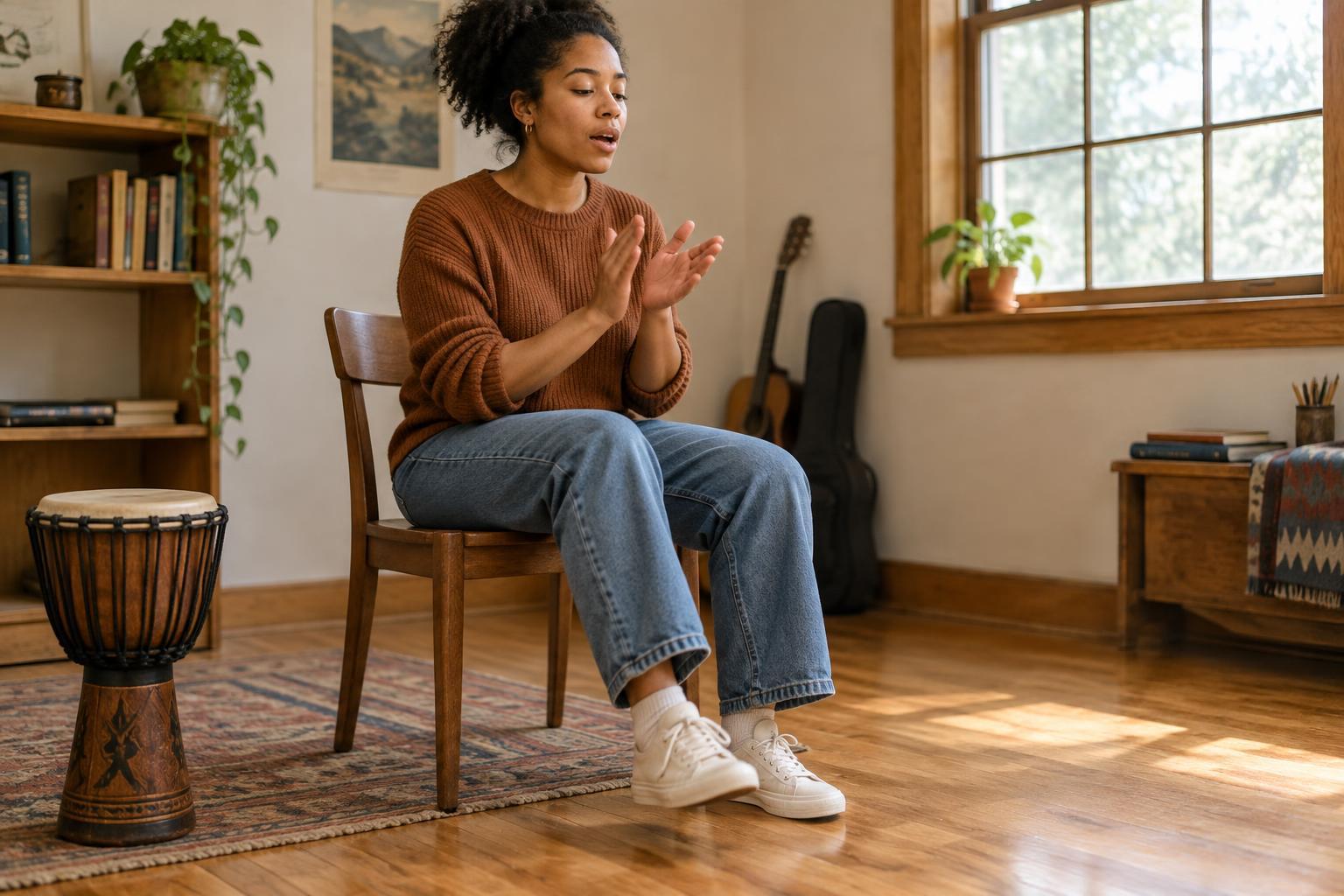
Next, stop stepping and clap on 1, 3, and 5 while continuing to count aloud. There should be one quiet count between claps, including between 5 and the next 1. When each part feels steady on its own, combine them. On 1, step and clap together. On 3, clap. On 4, step. On 5, clap. Counts 2 and 6 stay quiet, but keep counting through them.
Try four complete cycles, then pause. If the pattern slips, separate the parts again rather than pushing through at a faster pace. You can also say the actions as you move: “both, quiet, clap, step, clap, quiet.” Once you can repeat it, lower your counting voice gradually. The aim is to feel the spacing of both patterns, not to memorize a string of numbers.
Make the coordination more reliable
A common difficulty is letting the claps drift toward the steps. Notice that the first clap meets a step, the second clap arrives before the next step, and the third arrives after it. Resist changing the distance between claps to make them line up. If you become unsure, return to the six-count grid and check each action's place.
Practice keeping one layer quiet and the other clear. Make your steps light while your claps are easy to hear; then soften the claps and listen for the steps. You can also switch roles, clapping twice on 1 and 4 while tapping three times on 1, 3, and 5 with one foot or hand. The relationship stays the same even though a different body part carries each side.
For a further test, start with a few cycles of steps alone and add the claps without stopping the count. Later, remove the spoken numbers for one cycle and bring them back to check yourself. Short, accurate repetitions are more useful than a long run in which the spacing becomes uneven.
Carry the feeling into listening
The exercise gives you a way to recognize a rhythmic relationship, not a template to impose on every piece of music. While listening, you might notice one sound suggesting two broad pulses as another places three even sounds across the same span. Try following one part for a while, then the other, before hearing how they meet. If the grouping is unclear, it is fine to listen without assigning numbers.
Three-against-two appears in many musical settings, including music shaped by African and Afro-Cuban rhythmic traditions, but this exercise alone does not explain a whole tradition or the roles of its instruments. It is also not the same thing as 3–2 clave, which names an orientation of a particular clave pattern rather than this simple division of one span into three and two. Treat the step-and-clap pattern as a starting point: it can sharpen your coordination and help you listen more closely to how musicians organize time together.