Hear the güiro as part of the groove
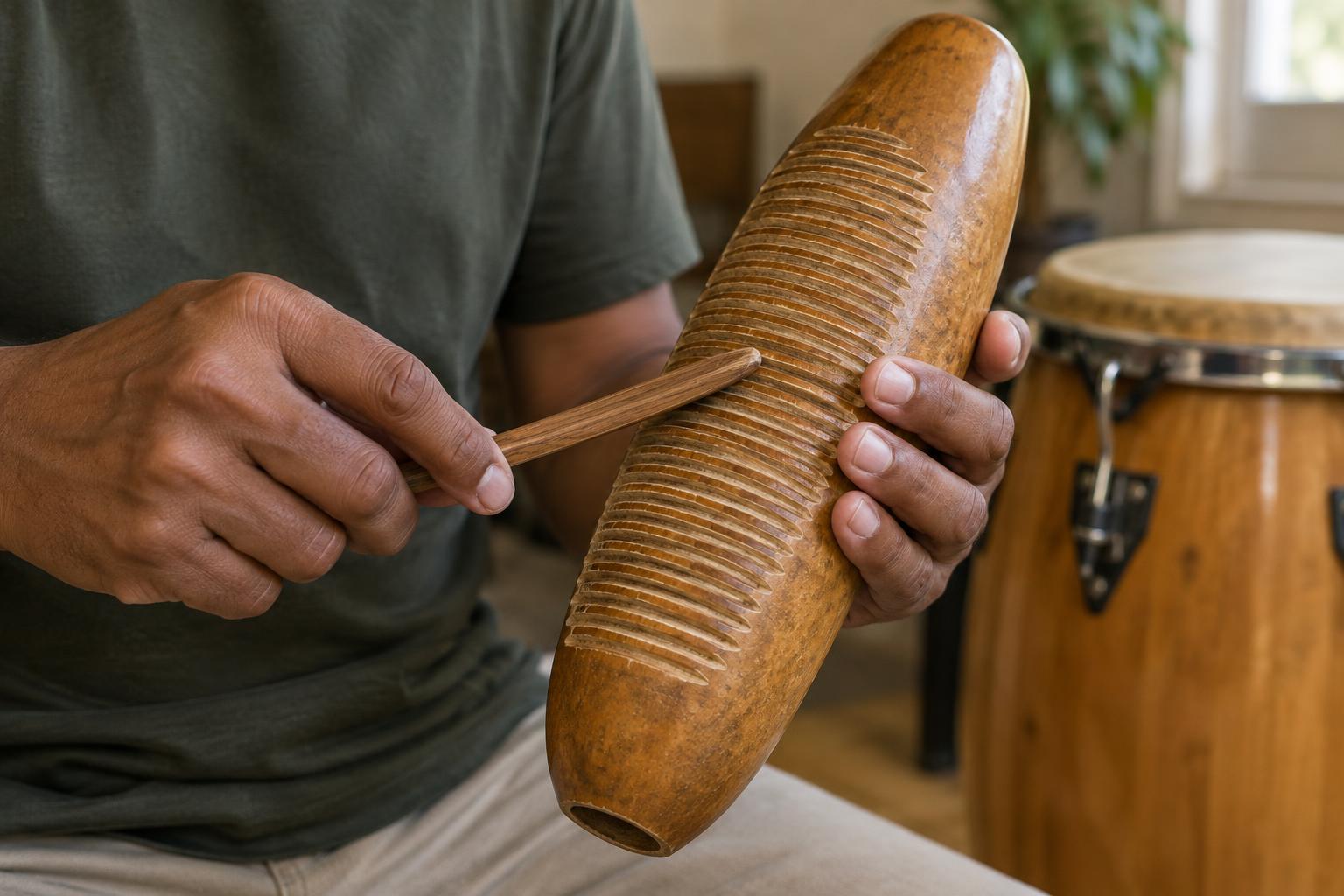
The güiro is a ridged percussion instrument played with a scraper. Traditional examples are made from gourds, while other instruments use different materials. Its distinctive sound comes from the scraper passing across a series of ridges: one motion can produce a textured rush, and a shorter motion can make a crisp accent. You may hear it in Afro-Cuban music and in other Latin American traditions, but its role and playing patterns vary with the style.
Listen to a güiro part as a repeating phrase rather than a string of identical noises. The contrast between longer and shorter strokes can help listeners feel where the beat sits and how the phrase moves around it. In an ensemble, a clear, steady part is usually more useful than the loudest or busiest one.
Find a secure, relaxed grip
Hold the body of the güiro so the ridges are accessible and the instrument can resonate freely. Depending on its shape, you might support it from underneath or hold it by a handle. Keep your fingers away from the path of the scraper, and avoid pressing so hard that you damp the sound or strain your hand. The aim is stability without squeezing.
Hold the scraper firmly enough that it will not slip, but leave your wrist and fingers able to move. Try a few slow strokes using a small wrist motion. If the sound catches unpredictably, check the angle at which the scraper meets the ridges before adding force. Different güiros and scrapers respond differently, so let the instrument guide how much pressure feels effective.
Comfort matters over a whole song. If your forearm tightens or your grip starts to creep, pause and reset. A position that feels natural for one instrument may not suit another, particularly when the body or ridge spacing differs.
Shape long and short scrapes
Scrape length changes both the sound and the time it occupies. A long stroke travels over more ridges, giving it a sustained, textured character. A short stroke crosses fewer ridges and can speak like a compact punctuation mark. Practice making each type recognizable without relying on a dramatic difference in volume.
Start with one long scrape followed by two short ones, leaving a little space after each motion. Repeat the sequence slowly. Make the long stroke last approximately the same amount of time on every cycle, then make the short strokes equally compact. Next, try the reverse direction of travel and notice whether the tone changes. There is no need to force both directions to sound identical; controlled contrast may be part of the phrase.
Let the scraper pass across the ridges at a steady pace within each stroke. Rushing the end of a long scrape can blur the next note, while pushing too hard can turn a short stroke into a harsh click. When the sound is uneven, simplify the motion before trying to play faster.
Keep the pulse while the strokes change
A repeating güiro pattern may alternate between sounds of different lengths, but the underlying pulse should remain dependable. Tap your foot or count four even beats aloud while playing a simple long-short-short phrase. Choose a slow tempo at which every stroke fits comfortably. If your counting wavers when you make the long scrape, shorten the motion rather than stretching the beat.
Then practice with a steady reference, such as a metronome or a recording you can hear clearly. First place one short scrape on each beat. Once that feels settled, replace one of those strokes with a long scrape while keeping the next beat in its original place. Record yourself if possible: playback can reveal whether your short strokes arrive early or your long stroke finishes late.
In Afro-Cuban ensemble music, listen for how your part sits beside the clave and other percussion rather than assuming every güiro pattern directly copies the clave. The appropriate phrase depends on the musical setting. If you are learning a specific style, listen closely to experienced players in that style and follow the pattern agreed on by your ensemble.
Make a simple part feel good
Once your hands and timing feel reliable, shift your attention outward. Can you hear the bass, the voices, and the other percussion while you play? Keep your strokes consistent enough to support them, then adjust your volume if your güiro is covering a quieter part. Leave room for accents and breaks in the arrangement; constant scraping is not always the best contribution.
A useful practice routine is brief: play slow, even strokes; alternate long and short sounds; repeat a phrase against a steady pulse; then play it while listening to music. Focus on one adjustment at a time. The goal is not to make the güiro complicated, but to give each scrape a clear shape and a reliable place in the groove.