Start with an even conversation between the hands
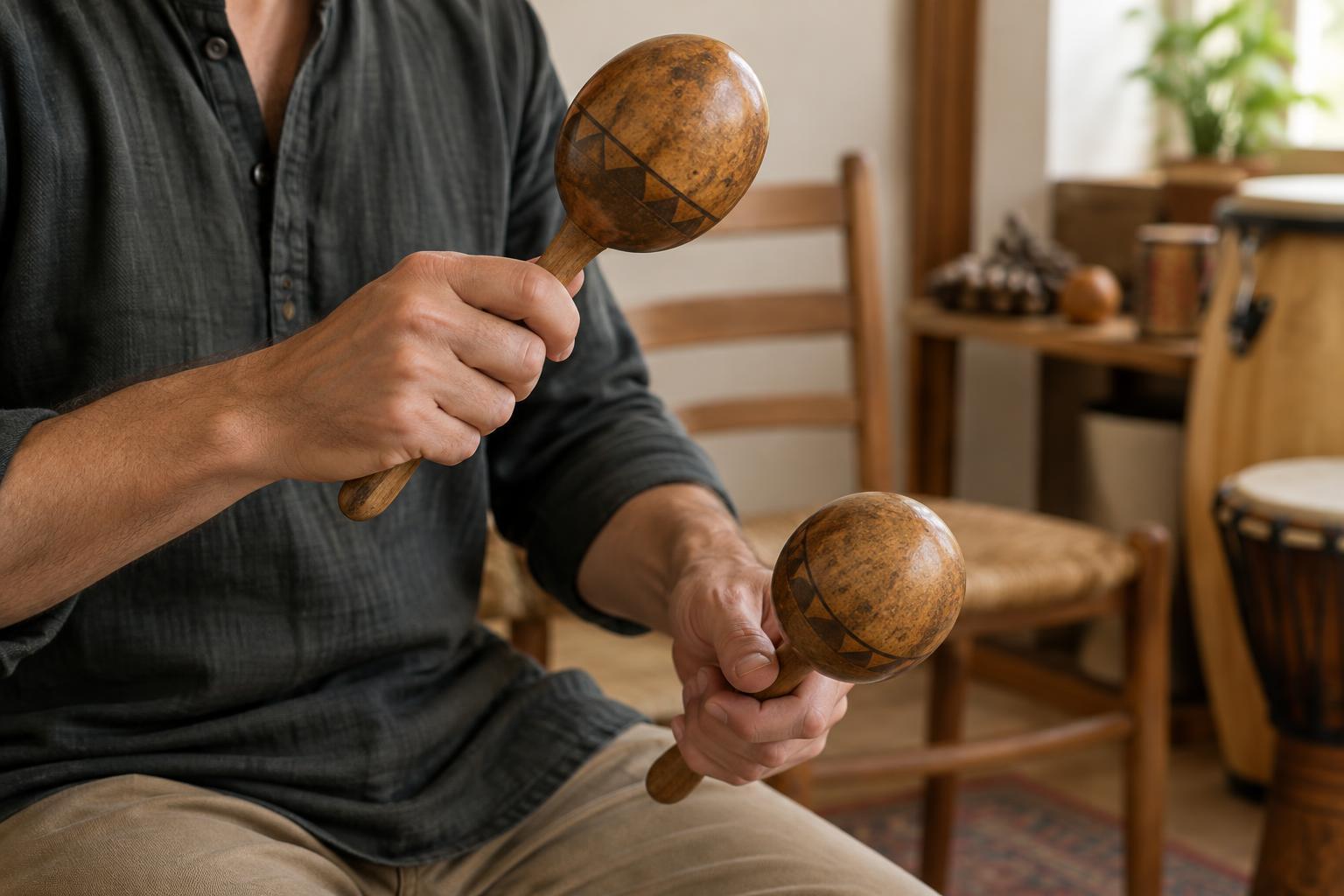
A maraca sounds when its filling moves against the shell. That makes the path of the hand important: a gesture that moves the filling decisively can sound crisp, while a loose, extended shake may produce a longer wash. Before working on accents, find a comfortable motion you can repeat. Hold one maraca in each hand without squeezing the handles, keep your shoulders relaxed, and let the movement come mainly from the wrist and forearm.
Count “one and two and three and four and” at a slow, comfortable pace. Play the right hand on each numbered beat and the left hand on each “and,” then reverse the roles. Aim for a regular sequence in which no stroke disappears. You are not trying to make both maracas identical; they may differ slightly in sound. The goal is to hear whether your hands are placing their sounds at even intervals. If the pattern becomes uneven, slow down and reduce the size of the motion.
Make an accent clear, not merely loud
An accent gives one sound more prominence than its neighbors. With maracas, a short, well-directed movement often communicates an accent more clearly than a large swing. Try playing eight alternating sounds, with the first sound a little stronger than the other seven. Keep the time between sounds unchanged. The quiet strokes matter: without a controlled background level, the accented stroke has nothing to stand out against.
Next, move the accent through the pattern. Accent the third sound for several repetitions, then the fifth, then the seventh. Notice which hand plays each one. Practice again starting with the opposite hand so that neither hand becomes your automatic “strong” hand. If the accent pulls the following stroke late, make the accented gesture smaller and return to the same relaxed motion immediately afterward.
You can also change the character of an accent rather than only its volume. Depending on the instrument, a more decisive stop or a slightly different direction of movement may produce a tighter sound. Experiment gently and listen to the result. Avoid gripping harder as your main accent strategy; extra tension can make the next few strokes less consistent.
Place accents inside a musical pattern
Once your hands alternate steadily, count two groups of four beats without stopping. Keep the same stream of sounds and choose just one or two places to emphasize across those eight beats. This is a useful way to feel a phrase that extends beyond a single bar. Say the counts aloud first, mark your chosen accents with your voice, and only then transfer them to the maracas. If you lose your place, return to an unaccented pattern and add one accent back in.
In Afro-Cuban music, percussion parts work in relation to other parts; an accent that feels exciting alone may crowd a vocal line or compete with another instrument. Clave can help organize how you hear a phrase, but it is not a cue to strike every clave sound with a maraca. Listen to a specific piece and identify where its maracas sit among the voices, drums and other instruments. Follow the part you hear rather than assuming one alternating pattern fits every style or arrangement.
Practice for steadiness and ensemble balance
Try a short practice cycle: play one minute of even alternation, one minute with a single repeating accent, and one minute returning to an even sound. A metronome can help you check your spacing, but record yourself occasionally too. On playback, listen for strokes that rush after an accent, for one hand that consistently overpowers the other, and for unwanted extra sounds between strokes. Change only one thing at a time on the next attempt.
Finally, practice at a volume that leaves room for other musicians. Play along with a recording at a modest level and see whether you can still follow the bass, melody and larger rhythmic pattern. Then remove a few of your accents: does the music feel clearer? Alternating hands provide the motion, but careful listening gives that motion purpose. The most effective maracas part is not necessarily the busiest one; it is the one whose steady sound and chosen accents support the whole arrangement.