What cáscara does
Cáscara means “shell” in Spanish. For a timbales player, it refers to rhythms played on the metal side of a drum rather than on its head. In Afro-Cuban-derived dance music, a shell part can provide a crisp, repeating texture while leaving space for the voices and other instruments. There is no single cáscara figure for every song: patterns, accents, and placement vary with the style and arrangement.
Think of the shell part as a conversation within the rhythm section, not a solo played continuously at one volume. The clave pattern helps organize the musical phrase, while bass, congas, and other percussion contribute their own interlocking parts. You do not have to play every clave stroke on the timbales. Your first goal is to hold a steady two-bar cycle without losing track of where it begins.
Set up a clear shell sound
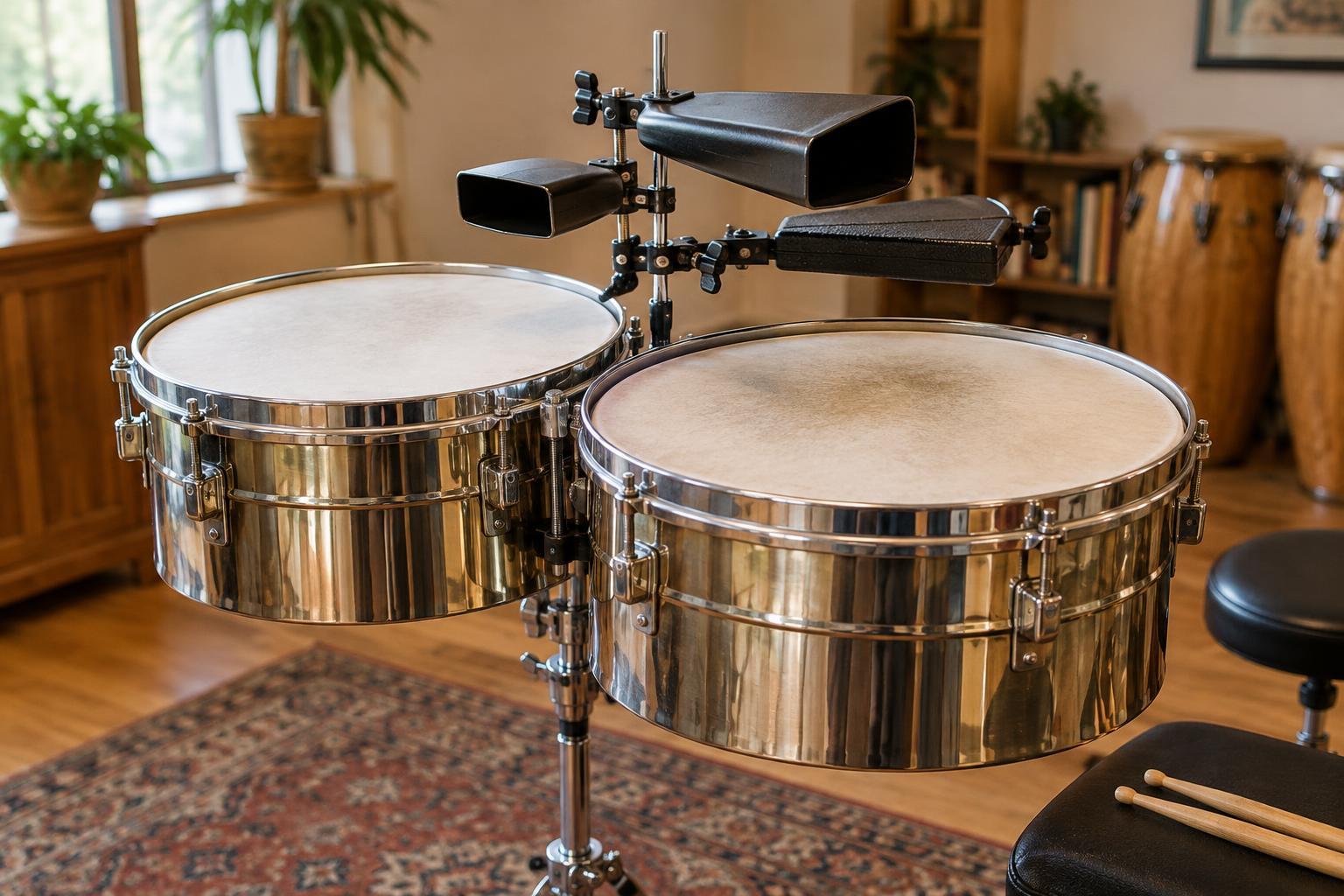
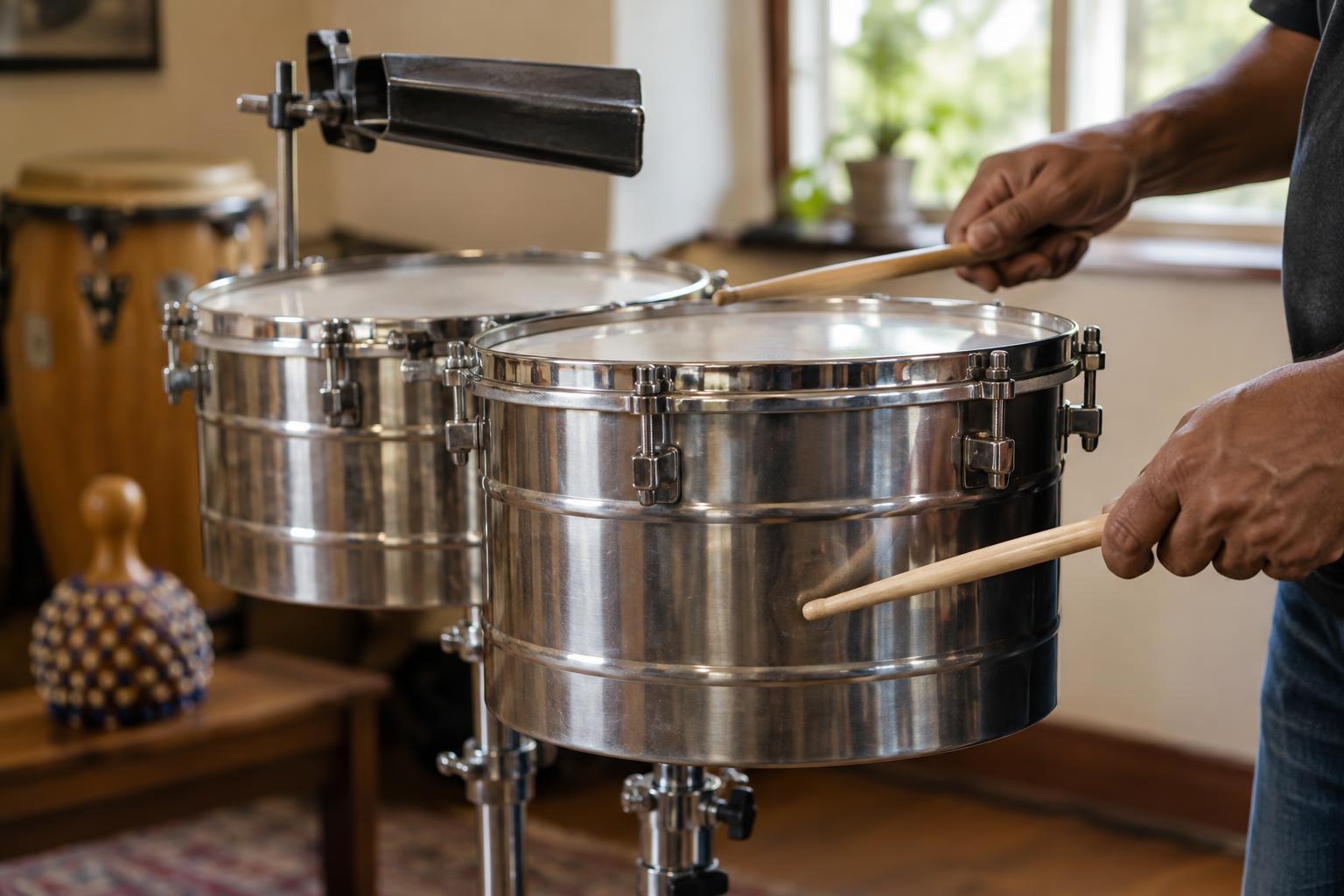
Use the side of the larger timbal if it is comfortable to reach, and hold one stick with a relaxed grip. Strike the metal shell with the tip or upper portion of the stick, adjusting the contact point until you get a clear, short sound. Keep the motion small and let the stick rebound. Hitting harder may make the part louder without making it clearer.
Start with your dominant hand alone so you can hear the pattern plainly. Count steady quarter notes aloud: “one, two, three, four.” Then add the offbeats, saying “one and two and three and four and.” Each “and” falls halfway between numbered beats. Tap your foot gently on the numbers; if the foot begins to follow your stick instead, slow down. A quiet, consistent foot pulse is more useful than a fast pattern that shifts against the beat.
Learn a two-bar practice pattern
Use this beginner-friendly shell figure to practice alternating between beats and offbeats. Count two bars of 4/4, repeating the count in each bar. In bar one, strike on 1, 2, 3, 4, and the “and” after 4. In bar two, strike on the “and” after 1, the “and” after 2, the “and” after 3, and 4. In compact form, where X means strike and a dash means rest, it reads: bar one, “X - X - X - X X”; bar two, “- X - X - X X -.” This is a practice version, not a claim that every cáscara part uses these exact notes.
Play bar one by itself until its final two strokes sound distinct: beat 4, then the “and” of 4. Practice bar two separately, keeping beat 1 silent. That rest matters; filling it in can obscure the start of the phrase. Join the bars at a tempo slow enough to count every subdivision aloud. Repeat the full cycle several times without stopping, and notice whether the final stroke of bar two leads naturally back to beat 1.
Once the notes feel secure, try a softer first pass and a slightly more pronounced second pass without changing the timing. Accents can help shape a phrase, but they should not become extra strokes. Record yourself for a few cycles if you can: check that the offbeats sit evenly between your foot taps and that the two bars remain easy to distinguish.
Place the pattern in the music
To connect the exercise with clave, listen to or clap a steady two-bar clave pattern while speaking the shell counts. Add the stick part only after you can keep track of both cycles. If the coordination is difficult, alternate tasks: clap clave for two bars, play shell for two bars, and repeat. This builds awareness of the shared phrase without treating clave as another sound to copy note for note.
Finally, listen to a timbales part in a full arrangement. Pay attention to when the player uses the shell, when they leave space, and when they move to bells or drumheads. Those choices help define the section of a song. Practice your two-bar figure quietly beneath a recording or with other musicians, and be willing to change or stop it when the arrangement calls for something else. A dependable cáscara part is not just a pattern you can play; it is a pattern you can place, maintain, and leave behind at the right moment.