What “charanga” tells you
In Cuban music, charanga usually names an ensemble built around flute and strings alongside a dance-music rhythm section. It is not a single beat. Charangas have played different repertories, and their instrumentation and sound have changed across time and from group to group. You may hear the term in discussions of danzón and cha-cha-chá, but identifying a charanga is less about guessing the name of a dance than noticing how its instruments share the work.
A useful starting point is the contrast between long, singing lines and short, repeating patterns. Flute and violins can carry melodies that rise above the groove, then shift into brief answers or tightly coordinated phrases. Underneath, piano and bass help establish motion, while percussion makes the pulse and its subdivisions easier to feel. The result can seem delicate at first listen, yet it is designed to keep dancers oriented.
Follow the melody, then listen behind it
First, pick out the flute. Its clear tone often makes it easy to follow, though it may weave around the violins rather than simply lead them. Notice whether it plays a complete melody, adds a flourish at the end of a phrase or leaves a space for another instrument. Then shift your attention to the strings. Violins may sustain a line together, answer the flute or repeat a compact figure that gives a passage its shape. Those roles can change within one performance.
On a second listen, let the melody become the background and attend to the piano and bass. The piano may mark harmony with repeated chords or a more active pattern; the bass gives those changes weight and helps you locate the recurring pulse. Try humming the bass movement while the flute plays. If you can keep it going when the melody takes an unexpected turn, you are beginning to hear the arrangement as connected layers rather than one busy sound.
Find the percussion without reducing it to a beat
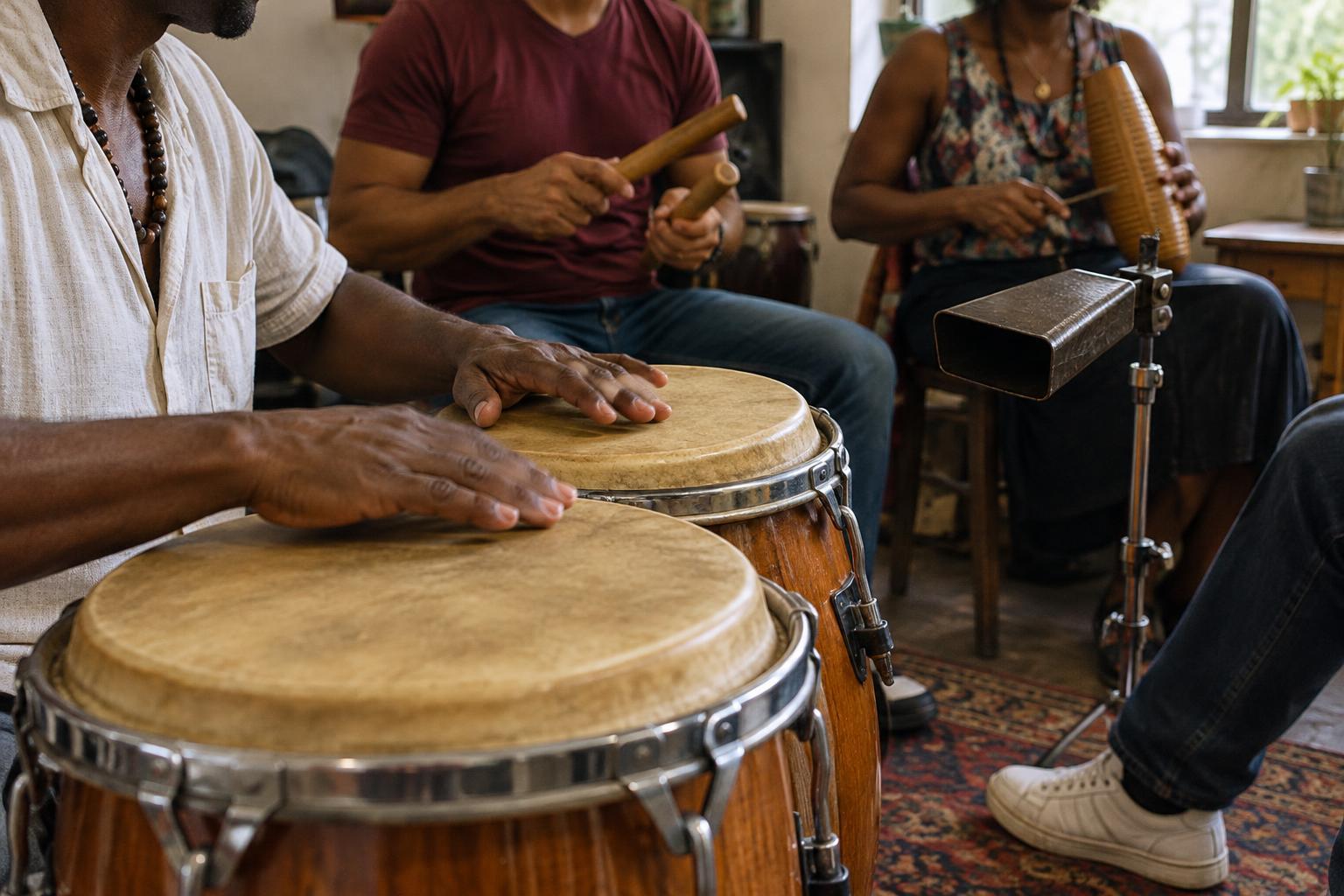
Timbales and güiro are familiar parts of many charanga sounds, though a particular recording may use a different combination of percussion. The güiro’s scraping pattern can provide a steady thread. Timbales can mark time, punctuate a phrase or announce a change with a fill. Other percussion, including congas in some ensembles, may add further patterns. Instead of trying to name every sound immediately, ask which part continues through a change in melody and which part calls attention to the change.
Rhythmic parts in Cuban dance music often relate to an underlying clave orientation, but the clave pattern is not necessarily played out loud. You do not need to force every accent you hear into a clave count to enjoy or understand a charanga. Begin by finding a comfortable pulse. Then notice how a fill or a new string figure sits against it without making the pulse disappear. That relationship between continuity and surprise is often more revealing than counting alone.
A three-pass listening exercise
Choose one charanga performance and listen to a short passage three times. On the first pass, tap the pulse gently and note where the musical phrases seem to end. On the second, follow just the flute and violins: when do they move together, and when does one answer the other? On the third, focus on bass, piano and percussion. Notice whether their patterns stay steady while the melody changes, or whether the whole ensemble shifts at once.
Write down observations rather than judgments: “flute enters after the strings,” or “timbales fill leads into a repeated piano pattern.” If describing what you heard feels difficult, browse Editing and Clarity · Wordcraft Journal for ways to make your listening notes clearer. For a different approach, try writing a short description of the ensemble’s changing texture; Creative Writing · Wordcraft Journal offers ideas for developing that kind of creative writing. Neither exercise requires you to identify a recording’s exact style before listening closely.
Finally, keep the ensemble’s social purpose in view. Charanga music belongs to Cuban musical histories and dance settings, not merely to a collection of instrument sounds. Listening for how the parts work together can deepen your appreciation while leaving room to learn more about the musicians, communities and occasions behind a particular performance.