Three jobs, one shared rhythm
When several percussion parts play together, it can be tempting to hear one complicated pattern. A more useful approach is to ask what each part contributes. The pulse is the recurring beat you might tap with your foot. Subdivision divides the space between those beats into smaller, regular units. Accents make certain attacks stand out, giving a pattern direction and character.
These are listening roles, not permanent labels for instruments. A drum may state the pulse in one arrangement and play around it in another. A bell may offer a steady reference while also marking a distinctive pattern of accents. Even silence can help: a gap in one part leaves room for another part’s note to become clear. Hearing these relationships is more useful than deciding which instrument is simply “keeping time.”
Find the pulse before following the busiest part
Start with a simple imagined ensemble in four beats. A low drum sounds on beats one and three, and a handclap sounds on beats two and four. Together, they make the beat easy to locate, though neither part plays every beat. If the low drum drops out for a measure, you may still feel the same pulse through the clap and through your memory of the pattern.
In real music, the pulse is not always sounded so plainly. A bass line, a dancer’s movement or a repeating phrase may help you find it. Try tapping evenly while listening, then see whether your tap remains steady when a prominent percussion part pauses or changes. If it does, you are beginning to separate the underlying beat from any single player’s notes.
An arranger can use this distinction to avoid unnecessary doubling. If a bass instrument and a drum already make the beat clear, adding another loud strike on every beat may crowd the texture. A lighter part could instead supply motion between beats or mark the start of a phrase.
Let subdivision create motion
Keep tapping four steady beats and say “one and two and three and four and.” The spoken “and” falls between beats, creating an even eighth-note subdivision. Now imagine a quiet shaker playing on every number and every “and.” The shaker adds a continuous sense of movement without changing the speed of your tap. If it plays only the “ands,” those in-between notes may feel especially noticeable.
Subdivision need not be equally prominent at every moment. One player might maintain a fine, soft stream of notes while another plays a more spacious pattern. The contrast helps listeners sense both the beat and the activity around it. Players also need to agree on how the smaller notes relate to the pulse: an evenly spaced pattern feels different from one in which the spaces are deliberately unequal.
When arranging, listen for whether two busy parts support each other or obscure each other. You can create clarity by changing volume, register or sound quality, or by removing notes. A quiet high sound between beats can remain audible above a sparse low-drum part without either player having to play harder.
Use accents to shape the phrase
An accent is a note that draws attention. It might be louder, but it can also stand out because of its timing, pitch, tone or the silence around it. Accents can point to a beat, answer another part or suggest how a longer phrase fits together. Two players can perform the same number of notes yet produce very different feels by accenting different ones.
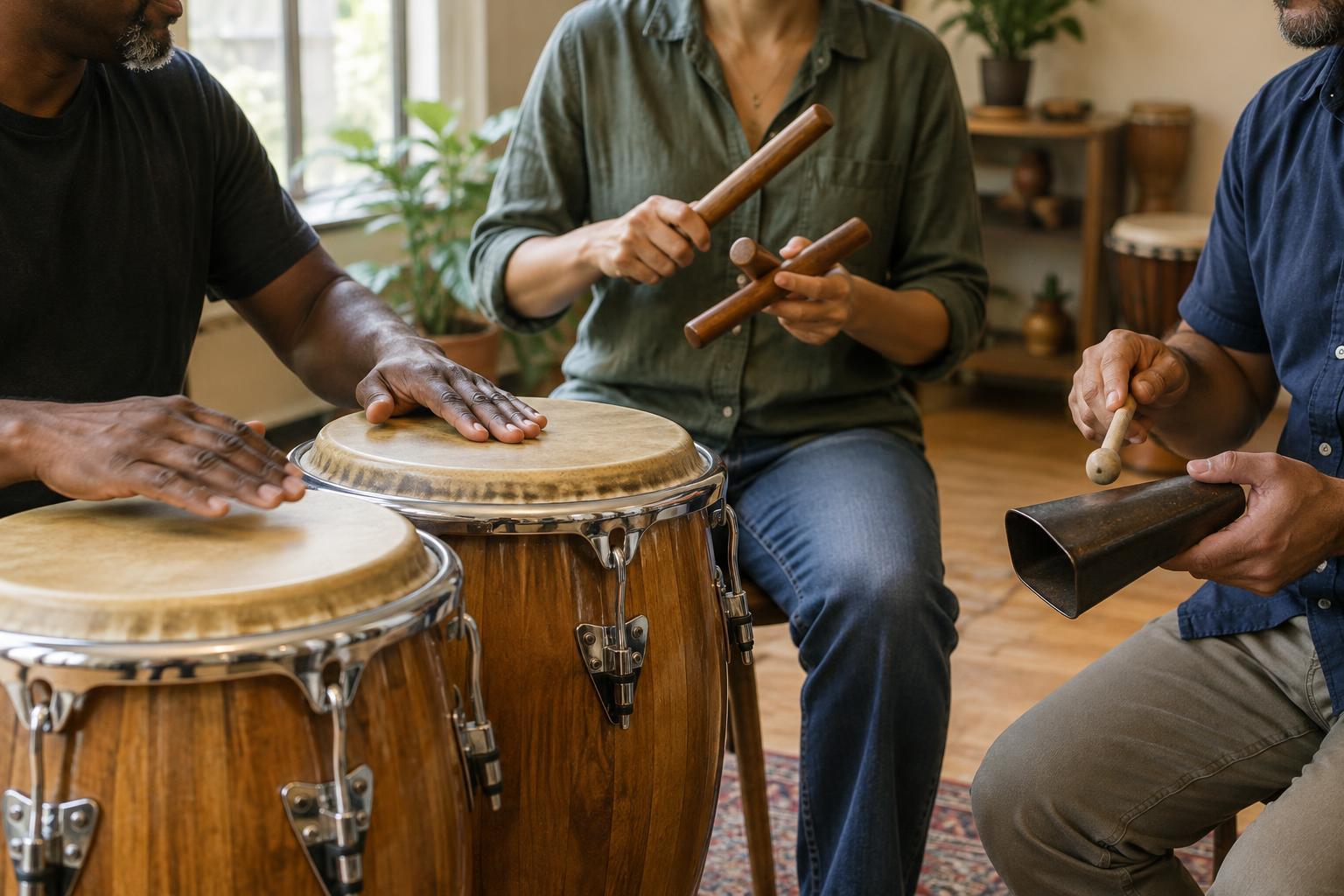
In many Afro-Cuban musical settings, musicians relate their parts to a recurring organizing pattern known as clave. Clave is not simply a metronome or a command for every instrument to strike at once. Depending on the tradition and arrangement, it may be played aloud or understood without being sounded. Its relationship to other parts calls for attentive listening and familiarity with the specific style, rather than a rule applied to all Afro-Cuban music.
For a general exercise in hearing accents, keep your four-beat tap and even subdivision. Clap softly on every beat for two rounds. Then make beats two and four stronger while keeping your tap unchanged. Finally, return to equal claps and notice how much of the phrase’s shape came from emphasis rather than added notes. This is a listening exercise, not a substitute for learning a particular tradition’s patterns from knowledgeable musicians.
Build an ensemble one layer at a time
To hear the division of labor, make a short loop with your voice, hands or simple instruments. First establish four steady taps as the pulse. Add a soft sound on the eighth-note subdivisions. Then choose just one or two notes in the loop to accent with a different sound. Repeat it long enough to learn where each layer sits, and take away one layer at a time. Can you still feel the beat when the taps stop? Do the accents still make sense without the subdivision?
Try the same questions when listening to a recording: what helps you locate the beat, what fills the spaces, and which sounds draw your attention across the phrase? More than one part may answer each question. The aim is not to reduce an ensemble to three rigid categories, but to hear how players make room for one another while creating a rhythm that moves as a whole.