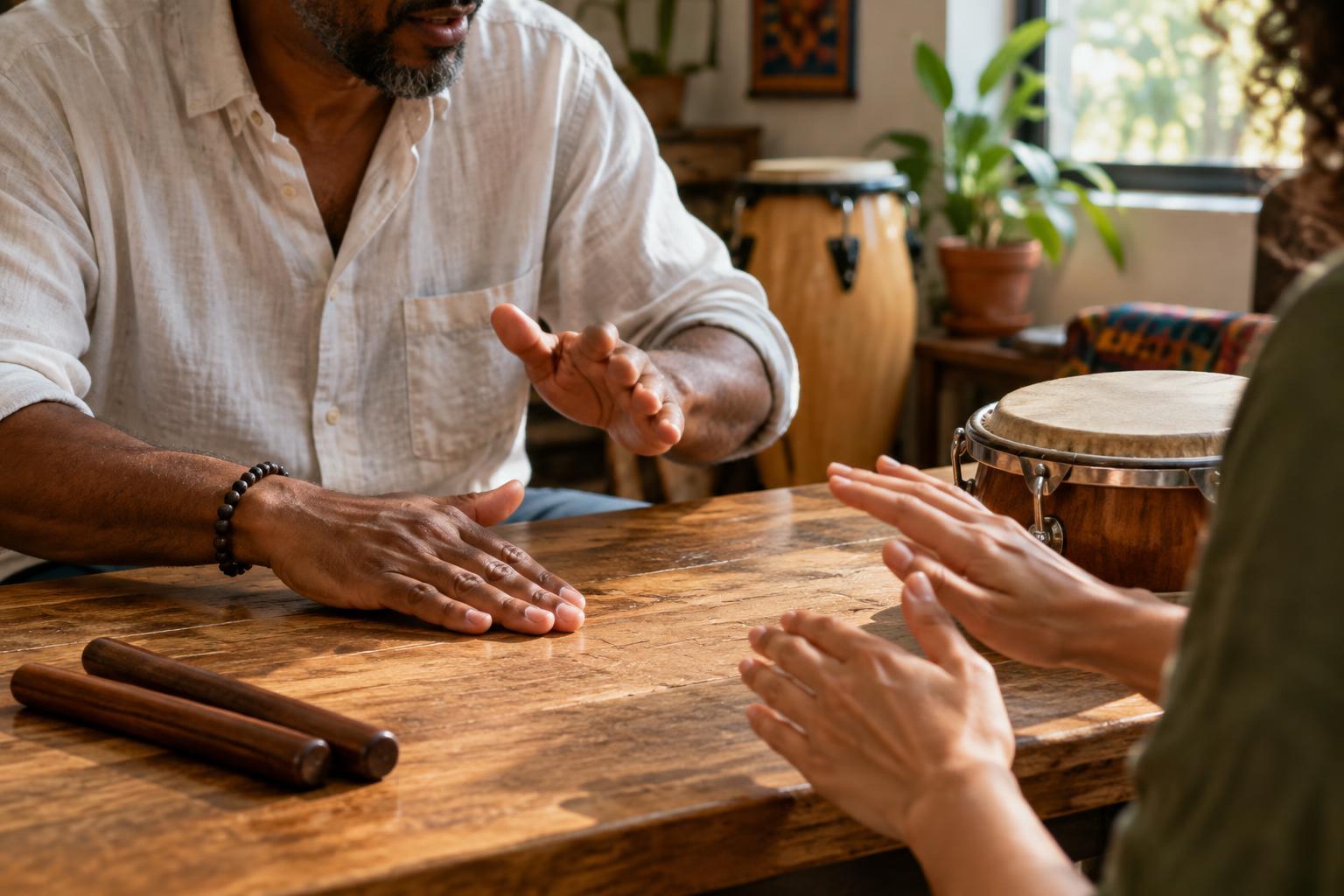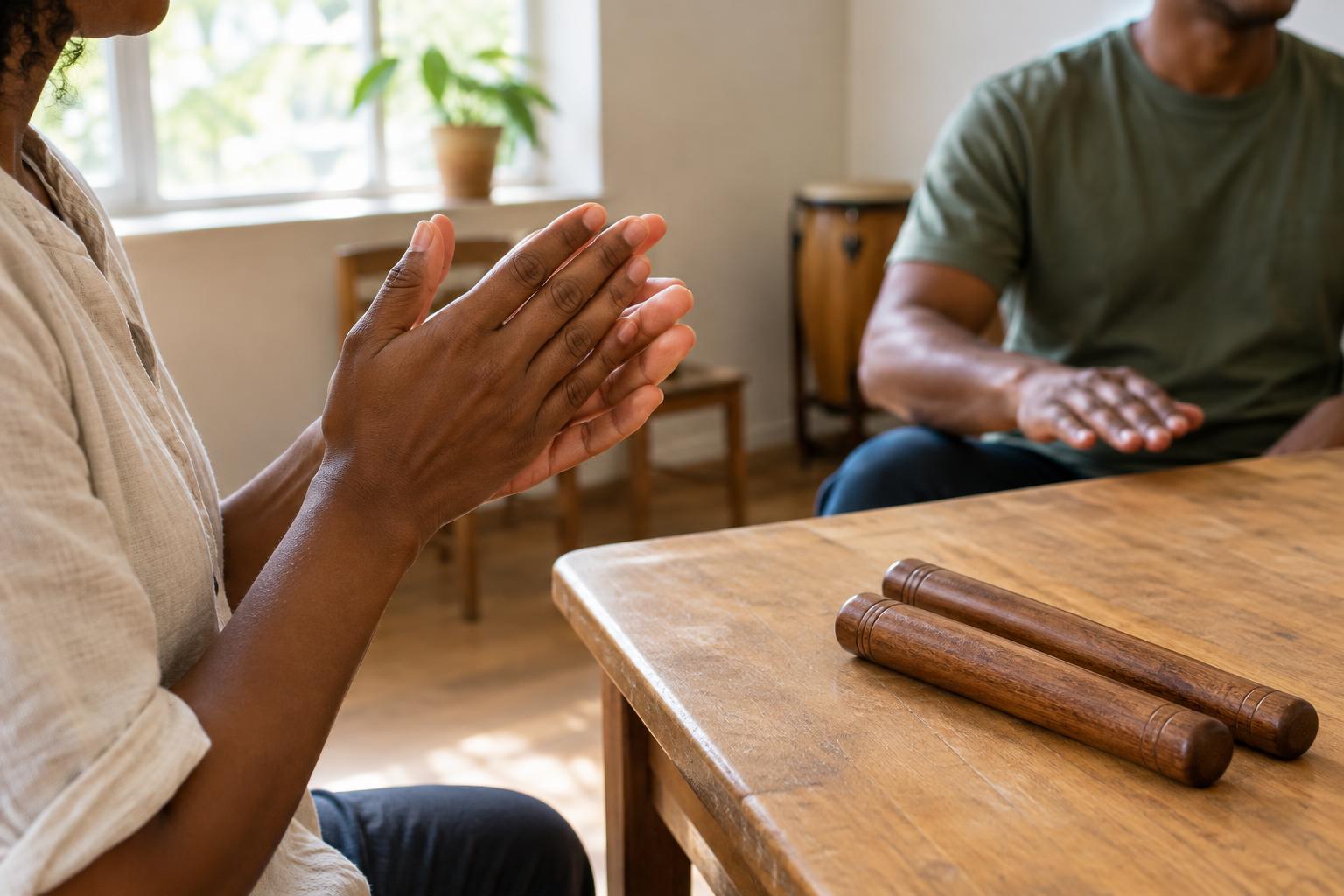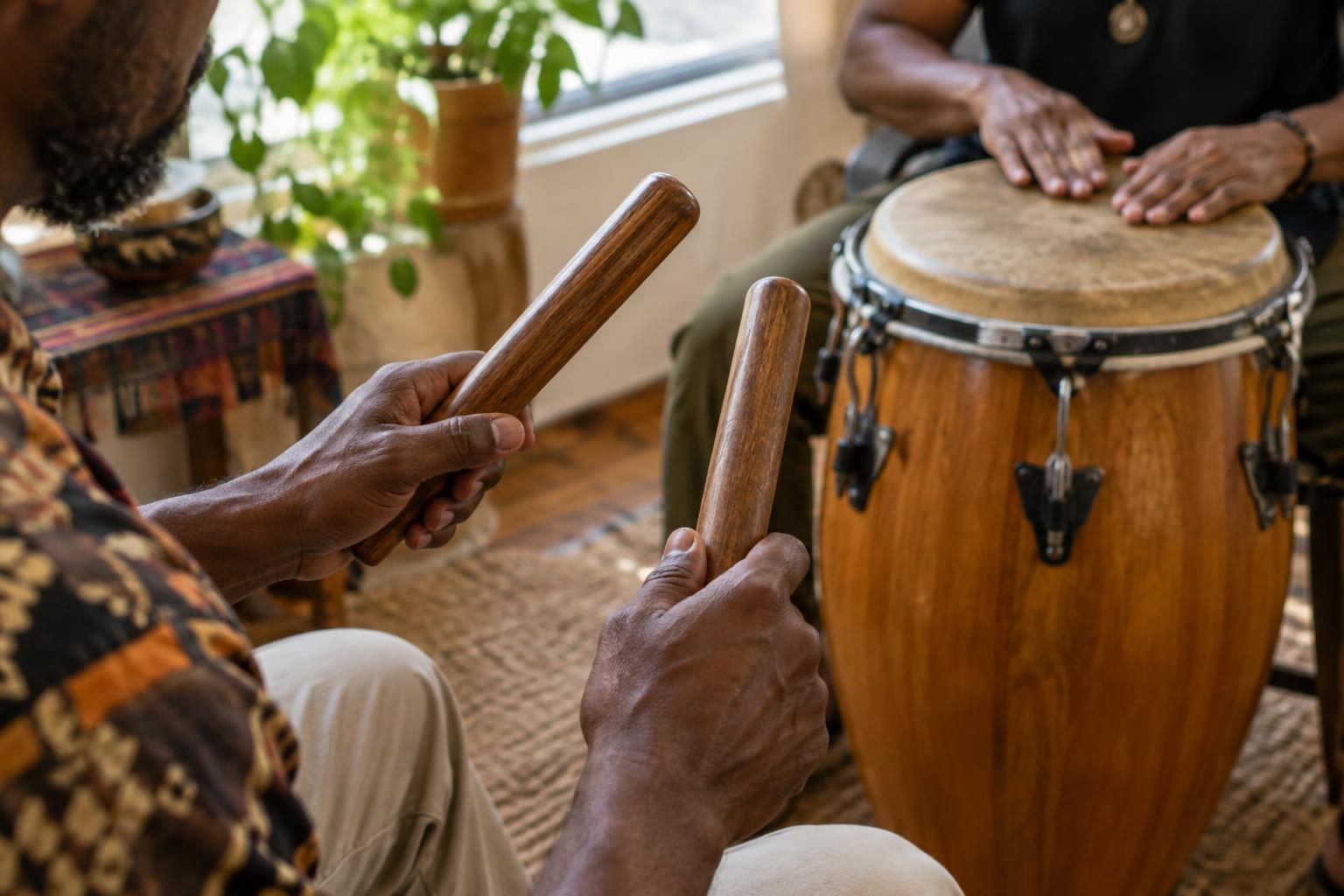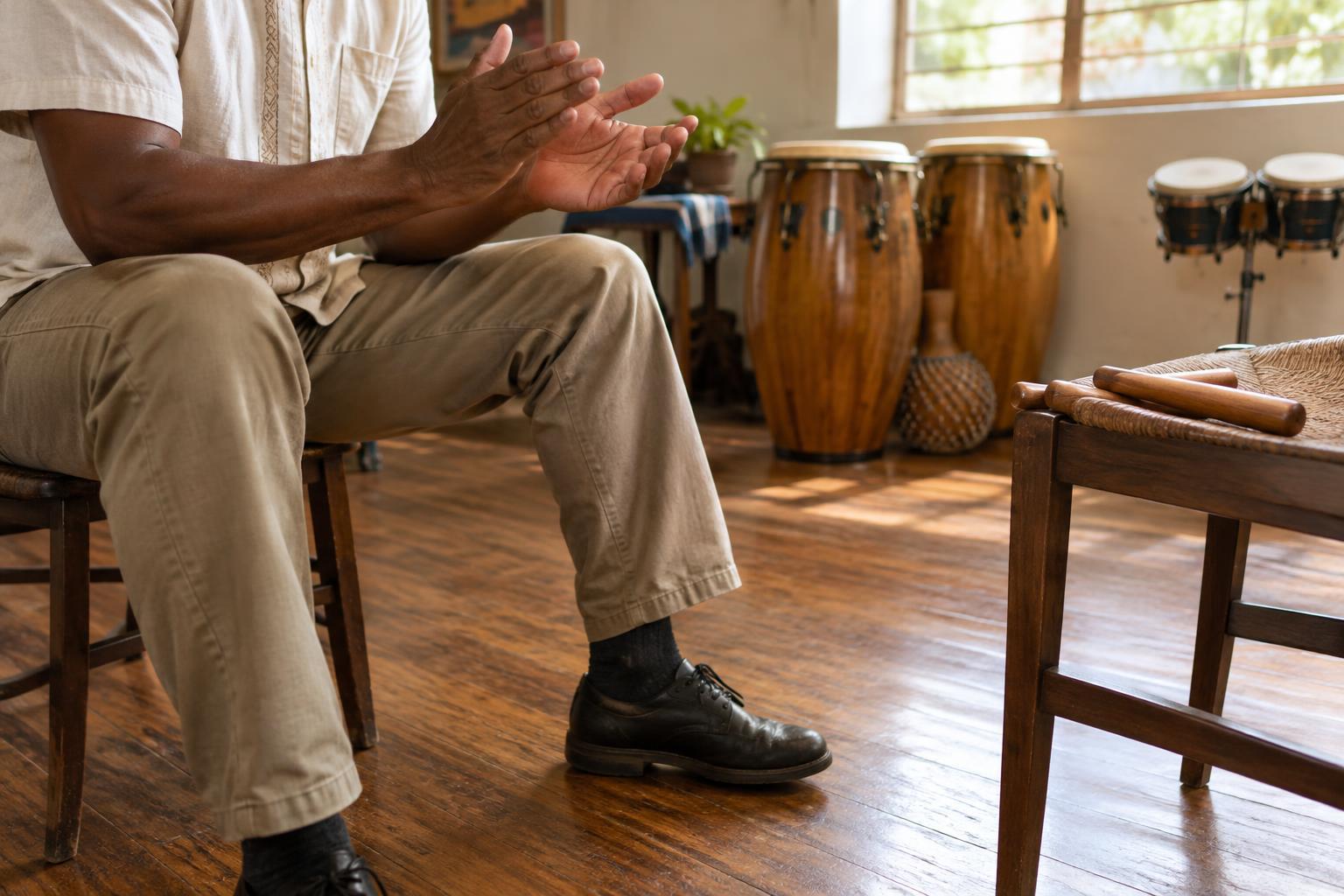
Set up the pulse
Son clave is a five-stroke rhythmic pattern associated with Afro-Cuban son. Its strokes are spread across two measures of four beats: one measure has three strokes, and the other has two. Calling the pattern 3–2 or 2–3 tells you which measure comes first. Practicing it can help you hear how a repeated rhythm relates to the underlying beat.
Sit or stand comfortably and tap one foot at an easy, even pace. Count aloud, “one, two, three, four; one, two, three, four.” Each number gets one foot tap. Keep the taps the same distance apart, including when your hands are silent. If you find yourself speeding up, slow down until you can count and tap without effort.
Learn the three-stroke and two-stroke measures
In the counting system used here, clap the three-stroke measure on beat 1, the “and” after beat 2, and beat 4. To find the middle clap, divide each beat into two equal parts: “one-and, two-and, three-and, four-and.” Your foot still taps on the numbers; your hands clap on “one,” “two-and,” and “four.” Say the count aloud while trying it. The clap after beat 2 should fall between foot taps, not on the next tap.
For the two-stroke measure, clap on beats 2 and 3. Continue tapping all four beats with your foot, even though you do not clap on beats 1 or 4. Practice each measure on its own for several repetitions. If your foot begins to follow your hands instead of marking every number, stop clapping and restore the foot pulse before trying again.
Connect the measures in 3–2 order
Start the two-measure cycle with the three-stroke measure, then play the two-stroke measure. Your claps fall on beat 1, the “and” after beat 2, and beat 4 of the first measure; then on beats 2 and 3 of the second measure. Count both measures aloud and repeat the cycle without pausing between them.
Pay attention to the transition from the second measure back to the first. After clapping on beat 3 of the two-stroke measure, your foot still marks beat 4; the next clap arrives on beat 1 of the new cycle. Try four slow cycles, then four more with a quieter count. The goal is not speed. It is to feel that the foot pulse stays steady while the claps make a pattern around it.
Reverse the order for 2–3
To practice 2–3 son clave, begin with the two-stroke measure: clap on beats 2 and 3. In the following measure, clap on beat 1, the “and” after beat 2, and beat 4. The five strokes have not changed; only the starting order of the two measures has. Keep tapping and counting through the opening beat 1, even though your hands are silent.
An easy mistake is to add a clap on that first beat because it feels like a beginning. Instead, let the foot announce beat 1 on its own and wait for beat 2 to clap. Repeat the full two-measure cycle several times. If you lose your place, return to spoken counting and practice just the two-stroke measure before joining the measures again.
Build independence, then listen
Once both orders feel secure, alternate them in separate practice rounds rather than switching halfway through a cycle. First play four cycles of 3–2, pause, and play four cycles of 2–3. Later, try keeping the foot going during the change. Record yourself if that helps: listen for evenly spaced foot taps and for the clap between beats 2 and 3 in every three-stroke measure.
These exercises are a starting point for listening, not a complete account of how clave works in Afro-Cuban music. In an ensemble, musicians may express the pattern through their parts even when no one is striking claves. When you listen to son, try tapping the beat first. Then see whether you can hear a repeating two-measure shape without forcing every sound you hear into your practice pattern.