What is an anticipated bass note?
A downbeat is the first beat of a measure. A bass anticipation happens when a note associated with an upcoming beat or chord arrives before that beat. Imagine counting steady eighth notes: “one and two and three and four and.” The bassist plays the next chord’s root on the “and” after four, just before the following one. The harmony may feel as though it has turned a corner early, even while the rest of the ensemble keeps the beat in place.
That early note might ring across beat one, or the bassist might leave space where you expected another attack. Either way, anticipation describes when the note begins, not simply how long it lasts. It is also different from rushing: a rushed note drifts ahead of the intended pulse, while an anticipation has a deliberate position within it. The listener can still feel where one belongs, even when the bass does not strike it.
Find the beat before following the bass
To hear an anticipation, first locate a steady reference outside the bass. Tap a comfortable pulse with the percussion, a repeated chord, or the pattern of a melody. Keep tapping through the end of a phrase. Then listen for a low note that changes pitch just before your finger lands on the next one. If your tap still feels secure, you are hearing two useful layers at once: the steady beat and a bass line that reaches ahead of it.
Try listening across several measures rather than judging a single note. Does the same placement recur before a chord change? Does a percussion accent or chord voicing confirm the new harmony later? An isolated low sound before beat one could be a pickup, a passing note, or part of a different phrase. Its role becomes clearer when you hear what follows.
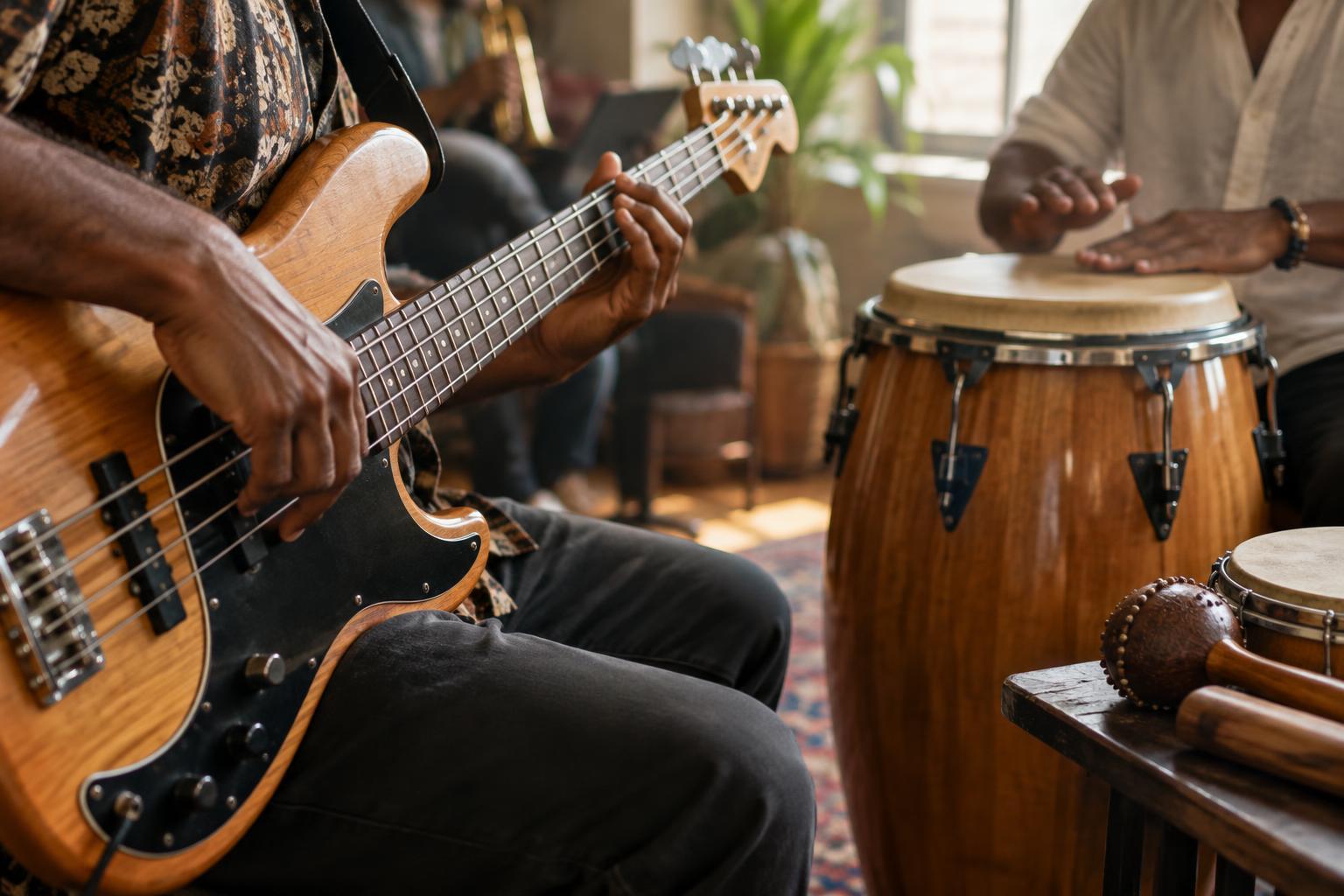
In some Afro-Cuban styles, bass lines often work with repeating percussion and piano patterns that make this kind of forward motion especially vivid. But there is no single bass pattern that represents all Afro-Cuban music. Listen to the particular ensemble and arrangement instead of assuming that every low note before a downbeat has the same function.
Why the space on beat one matters
Anticipation can create momentum without making the whole band louder or busier. When the bass establishes the next harmony before the measure begins, the downbeat may feel like a point of arrival even if no new bass note sounds there. The empty space gives room to a drum stroke, a chord, a horn entrance, or simply the continuing pulse.
This is why listening only for bass attacks can make the meter seem slippery. Your ear may want to label each strong low note as “one,” but another instrument may place the actual one just after it. Hold on to the shared pulse and notice how the early bass note leans toward that beat. The contrast between the two placements is part of the groove.
An arranger can use the same contrast deliberately. A bass anticipation may prepare a chord change while other parts wait, or a piano chord may join the bass early for a stronger push. If every instrument anticipates every change, that contrast can disappear. Keeping some parts anchored gives the early entry something to play against.
A short listening and playing exercise
Start without an instrument. Count four steady beats aloud, leaving equal space between them: “one, two, three, four.” Repeat until you can add “and” halfway between each beat without speeding up. Now say “next chord” on the “and” after four, but keep your foot tapping beat one at its original time. Repeat the cycle. The goal is to feel the early event and the downbeat as separate moments.
If you play bass, piano, or another pitched instrument, choose two easy chords. Play a low note from the first chord on beat one, then a note from the second chord on the “and” after four. Let that second note sound through the next beat one. Next, play the same change with the second note landing on beat one instead. Record both versions if you can. Which one feels as though it pulls you into the new measure?
Finally, try the exercise with a simple recording you already know. Tap the pulse, sing the bass line softly, and mark only the moments when a new low note arrives before your tap. You do not need to name the chords. Hearing the relationship between the note and the beat is the skill you are building.
Keep the whole arrangement in view
Bass anticipation is not a shortcut for identifying a style, nor a rule to add to every measure. Its effect depends on the tempo, the phrasing, the harmony, and what the other musicians play. In music organized around clave, pay attention to how a bass idea sits within the complete rhythmic conversation; avoid treating clave as an accent map that dictates every note.
The most useful question is simple: what stays steady when the bass moves early? Following that steady layer lets you hear the anticipation as an expressive choice rather than a misplaced beat. Once you can hear both at the same time, the bass line begins to reveal how an arrangement moves from one moment to the next.