Set up three distinct roles
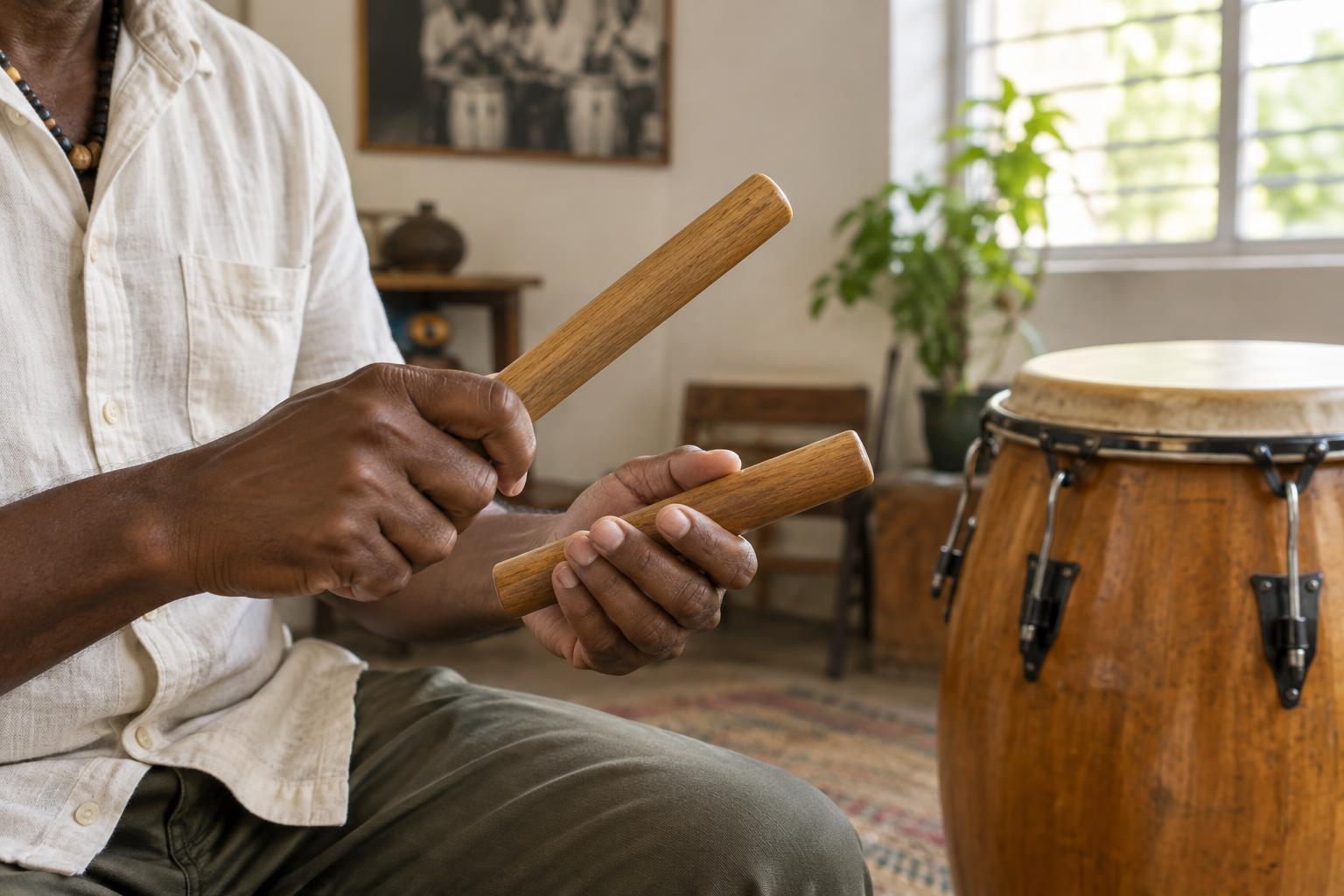
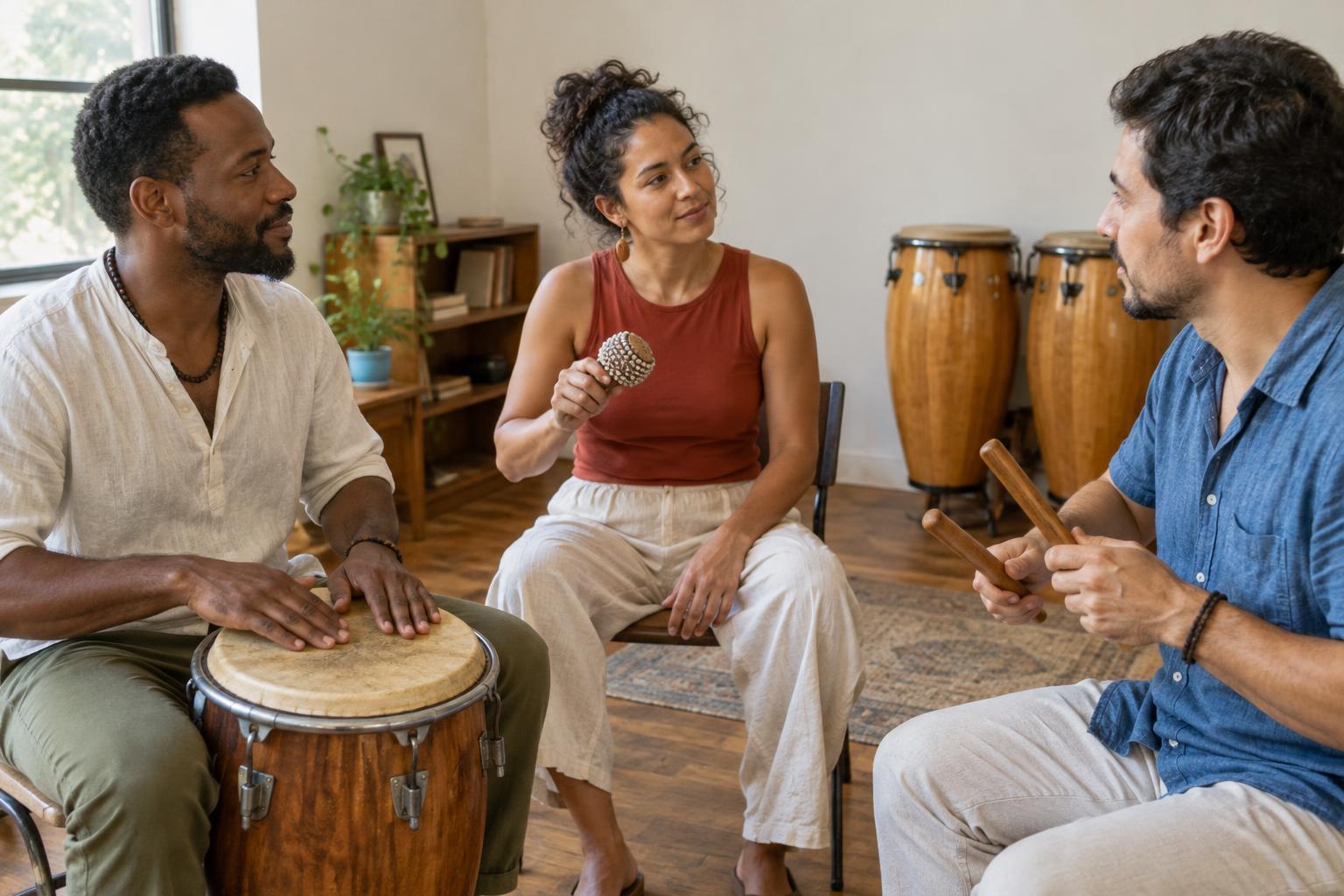
A practice circle makes rhythm easier to hear because each person is responsible for one layer. Seat three players where they can see one another. The first marks a steady quarter-note pulse, perhaps by tapping a knee. The second speaks or taps even eighth-note subdivisions: “1 and 2 and 3 and 4 and.” The third plays a clave pattern with two sticks or a quiet, crisp clap. Keep the sounds distinct and comfortable in volume.
Start at a pace where everyone can place a sound deliberately. The pulse player is not conducting or correcting the others; their task is to maintain an even reference. The subdivision player fills the space between beats without speeding up. The clave player listens to both while placing only the pattern’s notes. If the layers become hard to distinguish, make the subdivision quieter rather than playing everything louder.
Learn one two-bar pattern together
For this exercise, use 3-2 son clave in two bars of 4/4. In the first bar, play on beat 1, the “and” of beat 2, and beat 4. In the second bar, play on beats 2 and 3. Say the counts aloud before anyone picks up sticks. Then have the pulse and subdivision players begin together; add clave once their timing feels settled.
The numbers 3-2 describe the order of the three-stroke and two-stroke sides. They do not mean that one bar has three beats and the other has two. Keep counting four beats in each bar. Treat the two bars as a repeating phrase: after beat 4 of the second bar, the next beat 1 begins the pattern again.
Clave has a meaningful organizing role in many Afro-Cuban musical settings, and patterns and their use differ across styles. This exercise isolates one pattern to build coordination; it is not a complete account of how musicians use clave in an ensemble. When practicing a particular piece, listen to and learn its rhythmic setting rather than assuming every arrangement follows this example.
Rotate without losing the phrase
Assign players A, B and C to pulse, subdivision and clave. Repeat the two-bar pattern four times without changing jobs. At the end of the fourth repetition, switch roles: A takes subdivision, B takes clave and C takes pulse. After another four repetitions, rotate again so that everyone has played each part. Agree on the direction of rotation before starting.
The cleanest handoff is at the boundary between two-bar cycles. A player finishing the clave part plays beat 3 of the second bar, then listens through beat 4; the incoming player begins on beat 1 of the next bar. The pulse changes hands at that same beat 1. A small nod during the final bar can help, but avoid a shouted cue that obscures the rhythm. If a switch causes a gap, stop, count in together and try again at a slower pace.
Listen for relationships, not just accuracy
Each role reveals something different. While playing pulse, notice how some clave notes land with a beat and one falls between beats. While speaking subdivisions, notice that the “and” of 2 in the first bar has a different feel from an unaccented “and.” While playing clave, resist adding extra strokes to fill the rests. Those spaces help the two-bar pattern remain recognizable.
After a full rotation, ask each player what felt least secure. Did the pulse drift when the clave entered? Did the subdivision become accented only where clave sounded? Did anyone start the three-stroke side a bar early? Work on one issue at a time. For a useful check, let one player briefly stop sounding their part while continuing it silently, then re-enter at the start of the next two-bar cycle.
Vary the exercise with a clear purpose
Once the circle is steady, try fewer audible supports. Have the subdivision player speak only the “ands,” while still feeling every numbered beat. Or let the pulse player tap more softly and ask everyone to maintain the same pace. Change just one condition per round so you can tell what helped and what made the pattern harder to hold.
You can also practice 2-3 son clave by starting with the two-stroke bar—beats 2 and 3—followed by the three-stroke bar—beats 1, the “and” of 2, and 4. Keep the same pulse and two-bar length. Before switching, say which orientation you will use and begin again together. Finish by listening to music from an Afro-Cuban tradition you are studying, paying attention to how the pulse, subdivisions and ensemble parts interact. The circle prepares your ears; the music gives those roles context.