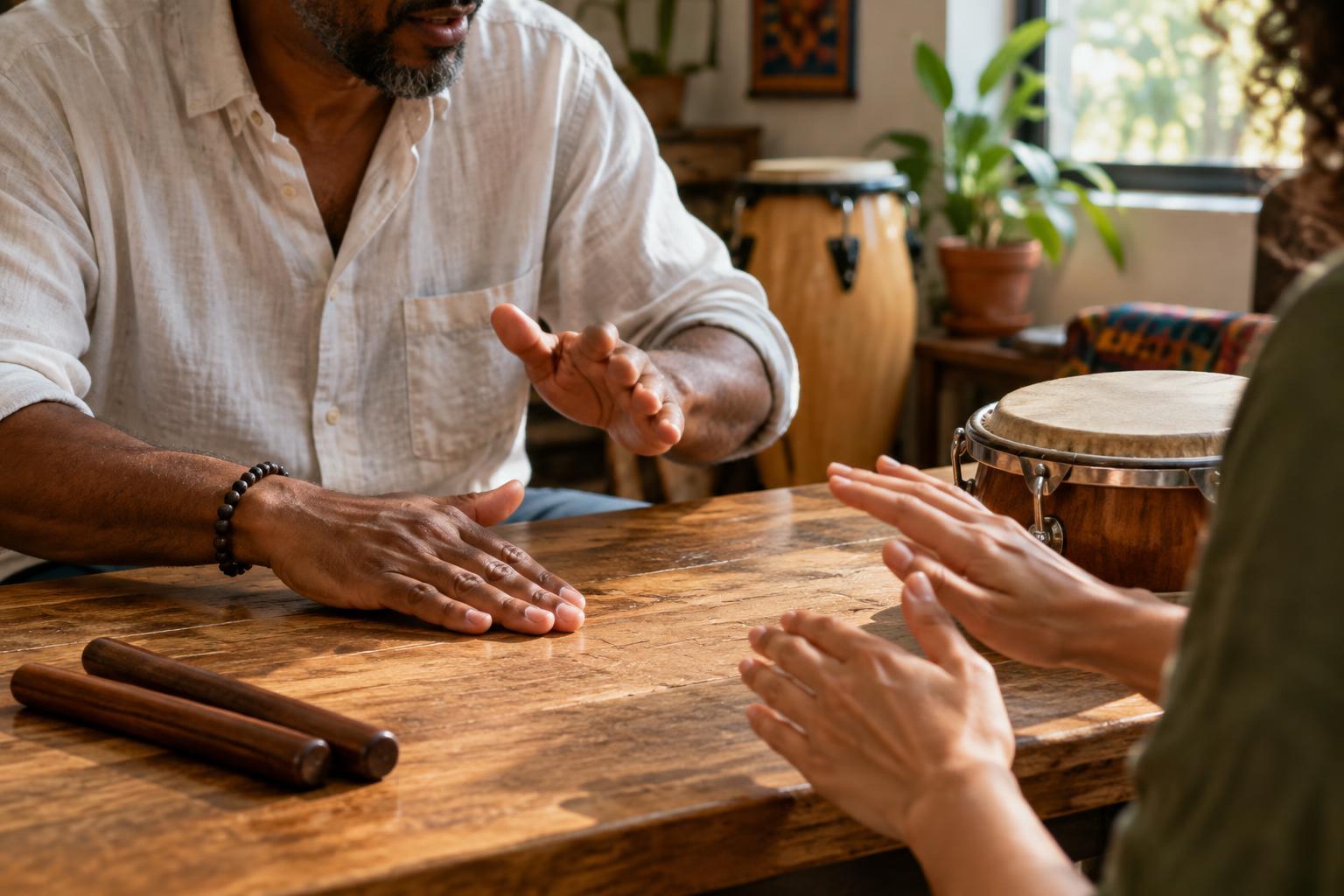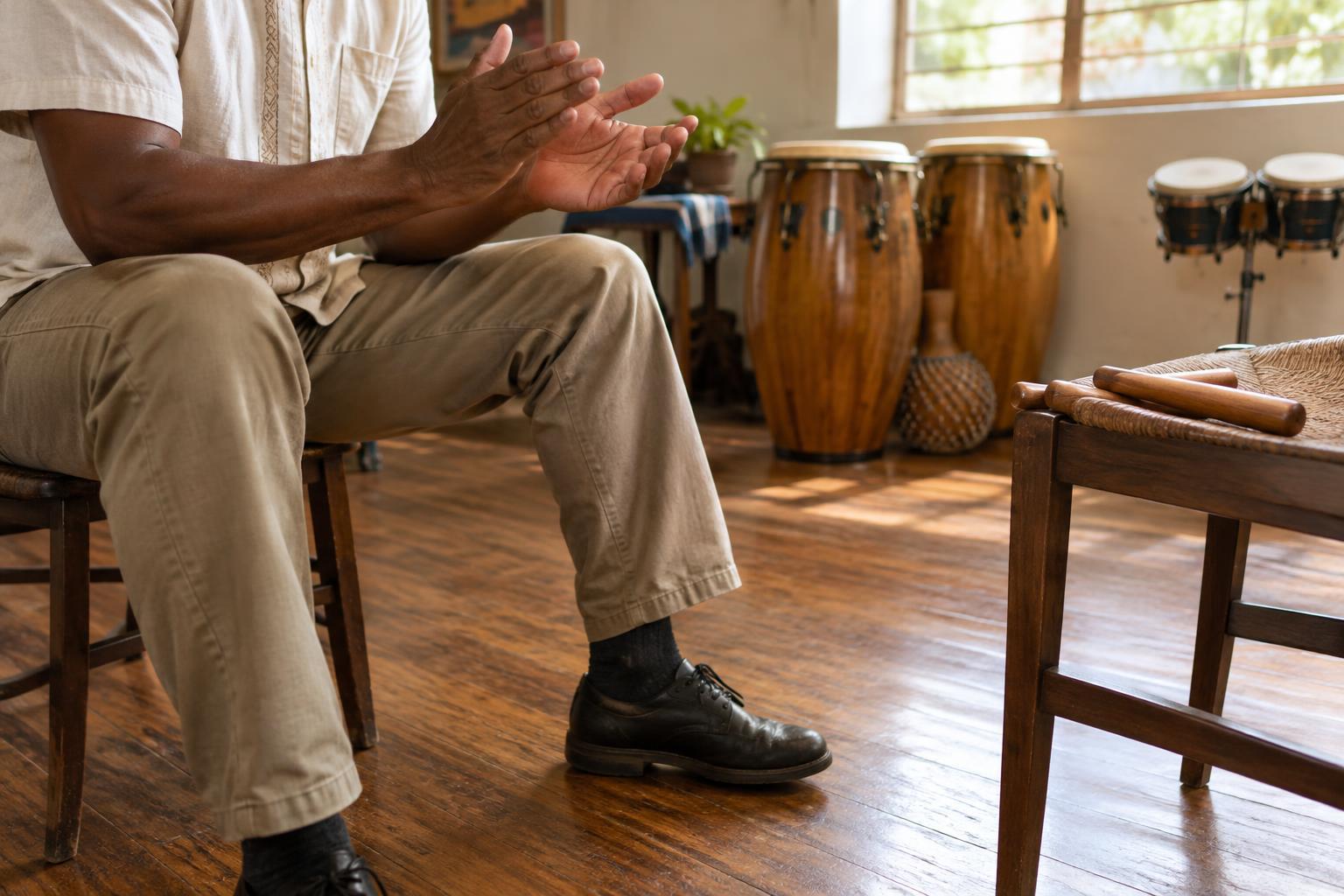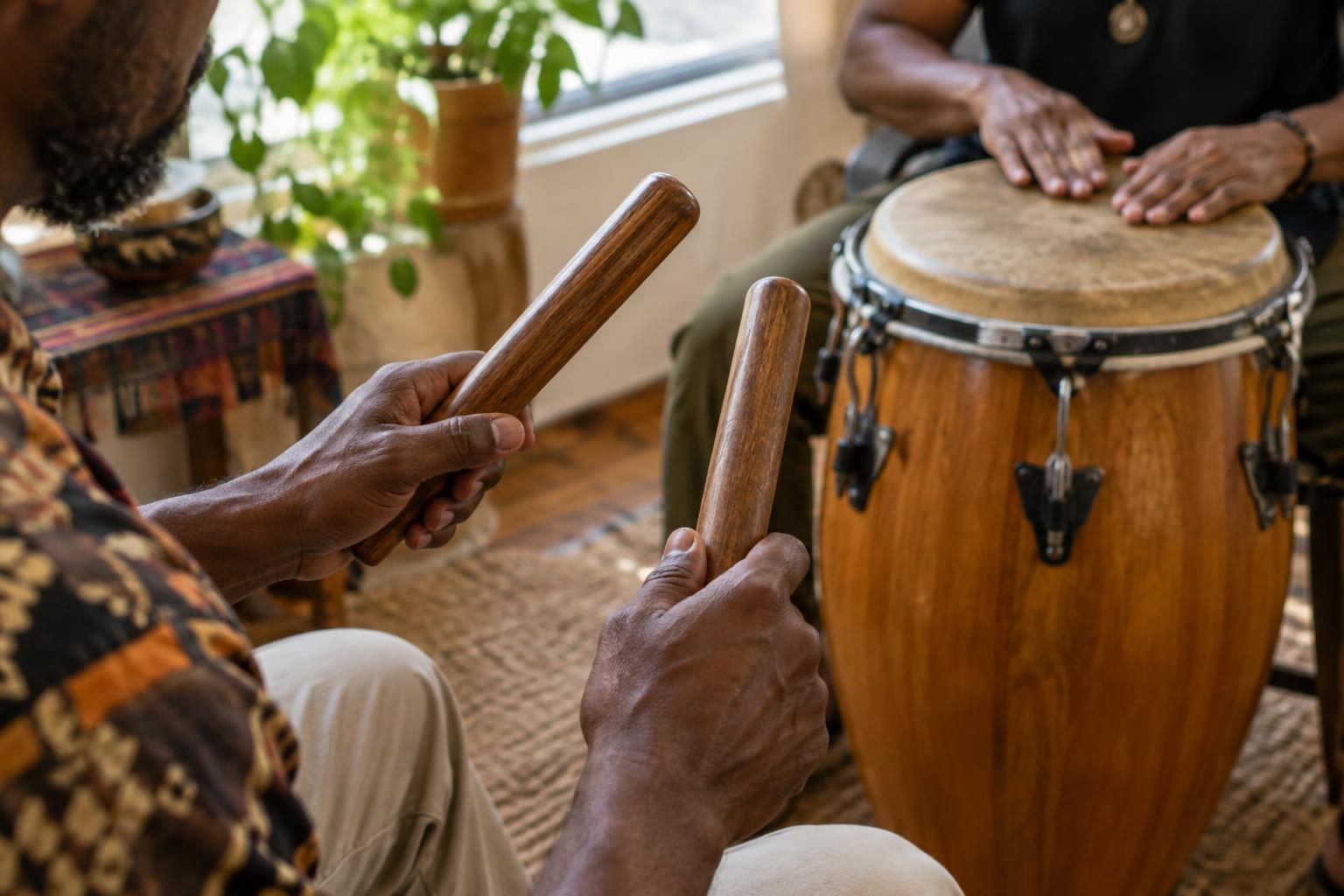
Find the stroke that needs attention
Rumba clave is a two-bar rhythmic pattern associated with Afro-Cuban music. In the 3–2 orientation, one bar has three strokes and the next has two. For this drill, count steady quarter-note beats aloud: “1 and 2 and 3 and 4 and.” Clap on 1, the “and” after 2, and the “and” after 4 in the first bar. In the second bar, clap on 2 and 3. Then repeat both bars without stopping.
The final clap of the first bar is the focus. In this common way of counting the pattern, it falls after beat 4, not on beat 4. That small displacement changes how the pattern leads into the next bar. Keep counting through beat 4 and place the clap on the following “and.” You should still feel the next beat 1 arrive in its usual place, whether or not you clap on it.
Clave is more than a set of isolated claps: musicians hear it in relation to a continuing pulse and to the parts around it. Slowing down gives you room to notice that relationship rather than rushing to complete the pattern.
Build a pulse before adding the claps
Start by speaking the count for two bars while tapping each numbered beat lightly with a foot or hand. Keep the taps even. The word “and” should land halfway between consecutive taps. Repeat until you can move from the last “and” of one bar to beat 1 of the next without pausing or speeding up.
Now count the two bars again and clap only on the “and” after 4 in the first bar. Leave every other subdivision silent. This deliberately sparse exercise makes the placement easier to hear. Your clap should arrive between the tap on 4 and the tap on the following 1. If it lands with either tap, reset and try a slower pulse.
Once that single clap feels comfortable, add the first bar’s other two strokes: clap on 1, the “and” after 2, and the “and” after 4. Keep tapping the numbered beats. Finally, add the second bar’s claps on 2 and 3. Count aloud throughout. A tempo slow enough for every spoken syllable to feel unhurried is more useful here than a particular number on a metronome.
Use contrast to catch an early clap
A useful check is to alternate between two versions of the three-stroke bar. In one pass, clap its last stroke on beat 4, as in the commonly taught 3–2 son clave pattern. In the next, clap it on the “and” after 4 for rumba clave. Keep the first two strokes and the second bar the same. Say “four” clearly over your pulse tap in both passes; in the rumba-clave pass, wait until you say “and” to clap.
Do not treat the two versions as interchangeable while playing with others. The contrast is a practice tool that helps you recognize exactly what you have changed. After a few alternating passes, return to rumba clave alone for several complete cycles. If you find yourself drifting back to a clap on 4, practice the single displaced clap again before rebuilding the whole pattern.
Listen for the two-bar shape
When the claps are secure, reduce the spoken count to a quiet whisper, then count internally while keeping the pulse tap. Listen to how the last stroke of the three-stroke bar points toward the next bar without replacing its first beat. Avoid adding an extra clap on that beat 1 to make the transition feel easier; the space is part of what you are learning to hold.
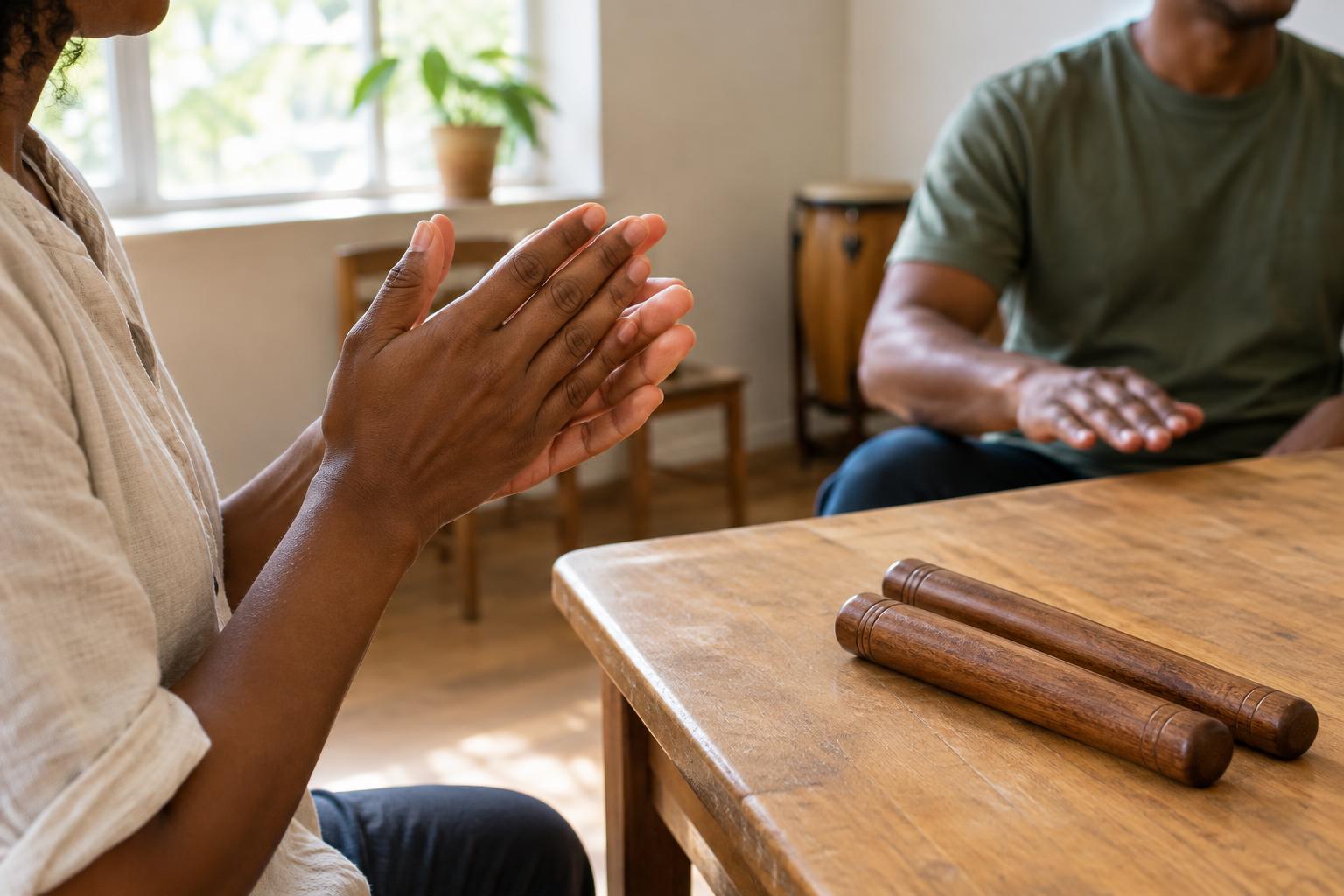
Try several cycles with a partner: one person taps the beats and the other claps clave, then switch roles. The pulse player should not follow the claps; the clapper should place each stroke against the steady beats. You can also record a short practice pass and listen for whether the taps stay even as you cross the bar line.
Rumba clave has a place within living Afro-Cuban musical traditions, where rhythm is learned through listening, participation and relationships among parts. This drill isolates one timing detail; it is a starting point, not a substitute for hearing the pattern in music. Once you can clap it slowly, listen for its two-bar shape in context and notice how other parts relate to it.