Start with your feet
A steady pulse is the regular sequence of beats you might tap along with while listening to music. It is not the same as every sound in the music: a melody or percussion part can leave space, rush across several notes, or emphasize unexpected moments while the pulse continues underneath. Walking offers a physical way to notice that continuity. In this drill, each step represents one beat, and your hands add patterns without asking your feet to change speed.
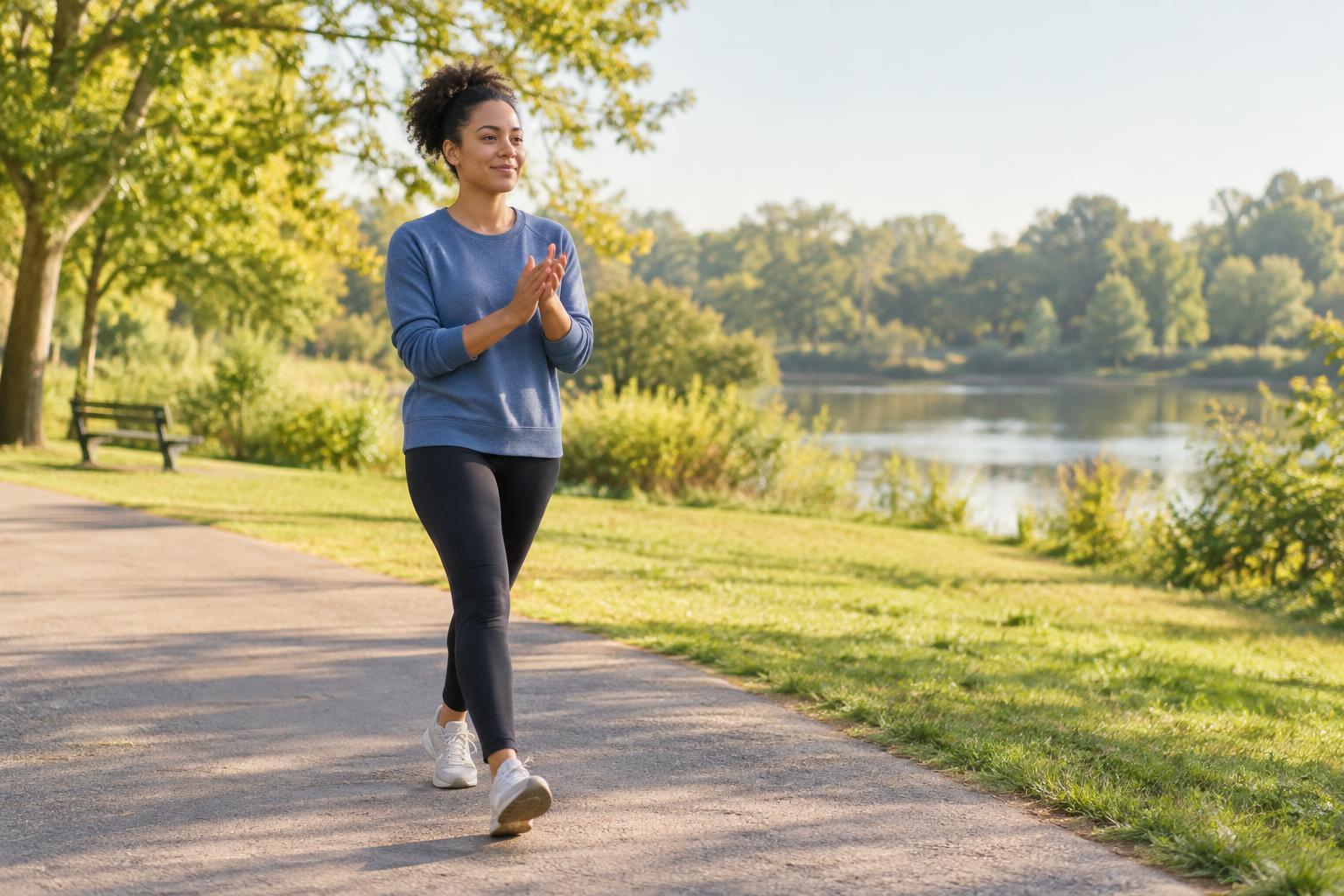
Choose a clear stretch of space where you can walk safely without watching for obstacles. Walk at a natural pace rather than trying to match a particular recording. If walking is uncomfortable or impractical, you can alternate gentle foot taps while seated. Keep the movement small and relaxed. The aim is to feel an even beat, not to walk fast or clap loudly.
Minute one: find a comfortable pulse
Begin walking and silently count one, two, three, four, repeating the count as each foot lands. Let every number take the same amount of time. Avoid making the first step so strong that the next three feel hurried; the count is a guide, not a command to change your stride. For this first minute, leave your hands quiet and notice whether your steps stay roughly even as you turn around or shift your attention.
If the count makes your walking awkward, drop it for a few steps and listen to the rhythm of your feet. Then bring the numbers back. A useful pulse should feel sustainable. You do not need a metronome to begin, though you can try the drill with one later if you want to compare your walking pace with an external beat.
Minutes two and three: add and subtract claps
For minute two, clap softly at the same moment each foot lands. Keep counting one, two, three, four. Your steps are still the pulse; the claps simply make each beat easier to hear. Check that the clap does not pull a step early. If coordinating both actions becomes difficult, slow to a comfortable walk and try just a few steps at a time.
For minute three, clap only on one and three while continuing to step on all four counts. You will hear a clap, a step without a clap, another clap, and another step without a clap. Try counting aloud briefly if it helps. The quiet steps matter: they show that the pulse continues when your hands are silent. After several rounds, switch to clapping on two and four without changing your walking speed. Notice how the emphasis changes even though the four steps remain evenly spaced.
Minute four: place a clap between steps
Now keep walking on the numbered beats and say “one and two and three and four and.” Each “and” falls halfway between two steps. Clap on the “ands,” not when a foot lands. Start by clapping on just one “and” per group of four steps if every gap feels too busy. You can add more as the spacing becomes clear.
This is a coordination exercise, not a test of speed. Take smaller steps or return to on-beat claps if your pace begins to wobble. It can help to think of the gap between steps as something you can feel, rather than a place you must hit with force. Keep your shoulders loose and your claps light.
Minute five: switch patterns, then listen
For the last minute, clap with every step for eight steps, then clap between steps for eight steps. Repeat the switch while keeping your feet as even as possible. If that transition is too demanding, alternate between clapping on every step and clapping only on one and three. When you lose your place, do not speed up to catch the pattern. Let your hands rest, recover the walking pulse, and rejoin on a count of one.
Afterward, try listening to a piece of music and gently finding a beat with your steps or foot taps before adding any claps. Ask whether a sound falls with your step, between steps, or across several steps. In Afro-Cuban music, patterns such as clave organize rhythm in ways that are more specific than this basic walking pulse; this drill is preparation for hearing those relationships, not a substitute for learning the patterns themselves. Return to the five minutes regularly and favor ease and consistency over complexity.